






What's Happening?
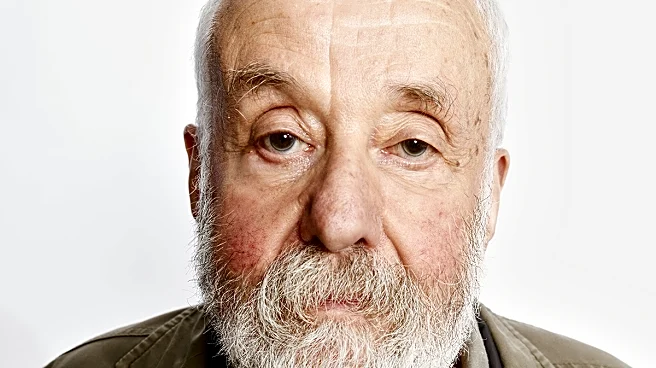
Veteran actor Michael Caine has discussed his approach to method acting, contrasting it with the more extreme physical transformations undertaken by actors like Christian Bale. Caine, who gained fame in the 1960s with films like 'Zulu' and 'Alfie,' never
received formal acting training but developed a natural ability to command the screen. He describes his method as using personal life experiences and 'sense memory' to evoke emotions, a technique he attributes to Stanislavski. Caine recounted an instance where he gained weight for his role as an alcoholic professor in the 1983 film 'Educating Rita.' Despite critical acclaim for his performance, which involved growing a beard and putting on weight to appear disheveled, he did not win an Academy Award for it. This experience led him to decide against such physical alterations for future roles, stating, 'I’m not doing that again!'
Why It's Important?
Caine's perspective offers insight into the varying philosophies within the acting profession regarding method acting and physical commitment to roles. His decision to forgo extreme physical transformations, particularly after not receiving an Oscar for 'Educating Rita,' highlights a pragmatic approach to his craft. This contrasts with the widely publicized and often celebrated physical sacrifices made by other actors, such as Christian Bale's drastic weight changes for films like 'The Machinist' and 'Vice.' Caine's success without consistently resorting to such methods suggests that profound physical alteration is not a prerequisite for critical acclaim or a lasting career. His emphasis on 'sense memory' and drawing from personal experience underscores a different, perhaps more sustainable, form of method acting that prioritizes emotional depth over physical mimicry.
What's Next?
While Caine has largely retired from acting, his reflections continue to influence discussions within the film industry about acting techniques and the demands placed on performers. His stance may encourage emerging actors to consider the long-term implications of extreme physical transformations on their health and career longevity. The ongoing debate about the 'best' approach to acting—whether it involves deep psychological immersion, physical alteration, or a more traditional, less intrusive style—will likely persist. Caine's legacy, built on a career spanning decades without consistent reliance on drastic physical changes, serves as a testament to the effectiveness of his chosen method and provides a counter-narrative to the often-glamorized extremes of method acting.
Beyond the Headlines
Caine's comments touch upon the broader cultural fascination with actors' physical transformations, often seen as a hallmark of dedication and a strong contender for awards. However, his experience with 'Educating Rita' reveals a less glamorous side: the effort might not always yield the desired recognition, prompting a reevaluation of its worth. This raises questions about the pressures actors face to conform to certain performance ideals and the potential health risks associated with rapid weight gain or loss. Furthermore, Caine's preference for 'sense memory' highlights the psychological and emotional depth of acting, suggesting that true immersion can be achieved without altering one's physical form. This perspective encourages a deeper appreciation for the internal work of acting, moving beyond superficial changes to focus on the nuanced portrayal of character.