
What's Happening?
Hyperliquid's HYPE token experienced a significant decline, falling 8.2% over 24 hours to $57.86, marking the steepest drop among the top 20 cryptocurrencies by market cap. This downturn follows the withdrawal
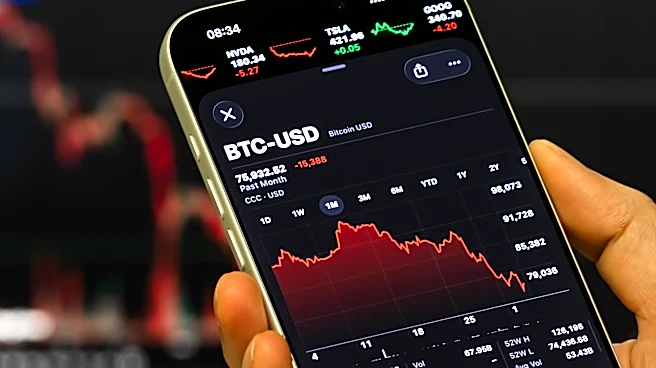
of Abraxas Capital, one of Hyperliquid's most profitable traders, which closed its entire book after nearly two years of trading on the platform. Abraxas Capital had traded $13.4 billion on Hyperliquid, generating $530 million in profits, including at least $67 million from funding payments, according to onchain analyst MLM. The firm's two accounts on Hyperdash, which previously recorded over $550 million in profits, now hold just over $5,000. Concurrently, Bitcoin slipped 1.7% to $58,801, and Ethereum lost 2.4%, contributing to a broader sell-off across risk assets. U.S. spot Bitcoin ETFs also recorded $231.6 million in net outflows on Tuesday, marking their sixth consecutive day of withdrawals, totaling $2.6 billion over this period. November's net outflows for these ETFs have reached $4.94 billion, surpassing previous records.
Why It's Important?
The sharp decline in Hyperliquid's HYPE token, triggered by the exit of a major trading entity like Abraxas Capital, highlights the significant impact that large institutional players can have on the volatility and price stability of specific cryptocurrencies. Abraxas Capital's substantial trading volume and profit generation on Hyperliquid underscore the influence of sophisticated market-neutral strategies in the decentralized finance (DeFi) space. The broader cryptocurrency market is also experiencing a downturn, with Bitcoin falling below $59,000 and Ethereum also seeing losses. This general market weakness is further exacerbated by record outflows from U.S. spot Bitcoin ETFs, indicating a shift in investor sentiment and potentially a broader risk-off environment. The bearish sentiment is also reflected in the options market, where the ratio of put options to call options has reached levels not seen since June 2022, suggesting traders are bracing for further price declines. This confluence of factors points to increased uncertainty and potential instability within the crypto ecosystem, affecting both individual tokens and the broader market.
What's Next?
The immediate future for Hyperliquid's HYPE token may involve continued price pressure, especially with upcoming token unlocks, which Eric Andersson, co-founder of Byrrgis, noted could add extra pressure, particularly on altcoins during market downturns. The broader cryptocurrency market will likely remain under scrutiny as investors monitor further outflows from U.S. spot Bitcoin ETFs and the prevailing bearish sentiment among options traders. While historical data suggests that high put-to-call ratios can sometimes coincide with price lows, they do not guarantee an immediate market reversal, as seen in past cycles. The market will be watching for any signs of stabilization in Bitcoin's price, as its performance often dictates the direction of altcoins. Further liquidations and continued uncertainty over interest rates could also contribute to sustained downward pressure across financial markets, impacting crypto assets. Stakeholders will be observing whether the current bearish trend deepens or if any catalysts emerge to reverse the negative sentiment and stem the outflows from investment vehicles.
Beyond the Headlines
The departure of a significant trader like Abraxas Capital from Hyperliquid raises questions about the sustainability and resilience of decentralized exchanges that rely heavily on large liquidity providers and sophisticated trading firms. While decentralization aims to reduce single points of failure, the impact of one entity's exit on HYPE's price demonstrates that even in DeFi, concentrated capital can exert considerable influence. This event also underscores the ongoing maturation of the crypto market, where institutional actions, such as ETF outflows and large-scale trading firm withdrawals, are increasingly shaping market dynamics. The growing bearish sentiment in the options market, reaching levels not seen in years, suggests a deeper re-evaluation of risk by market participants, potentially signaling a shift in the broader investment landscape beyond just cryptocurrencies. This could lead to increased regulatory scrutiny on market manipulation and concentration of power within decentralized platforms, as well as a re-assessment of risk management strategies by both retail and institutional investors in the crypto space.