

What's Happening?
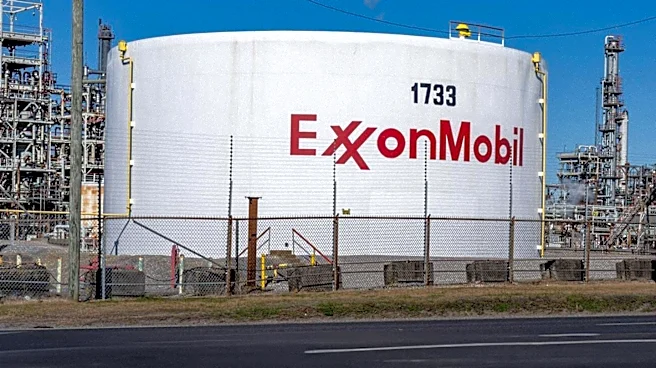
ExxonMobil, led by Chairman and CEO Darren Woods, has signed a memorandum of understanding (MoU) to explore potential upstream oil opportunities in Venezuela with the state-owned oil firm PDVSA. This development marks a significant shift from Woods' earlier
assessment of Venezuela as 'uninvestable' at the beginning of the year. The MoU is described as a crucial first step, but ExxonMobil emphasizes that any future investment will depend on stable policies, clear regulations, strong investment protections, and competitive returns. Woods has maintained a cautious public stance, acknowledging that while progress is being made on fiscal and legal regimes and investor protections, there is still considerable work ahead. This move could potentially lead to ExxonMobil's return to Venezuela after nearly two decades, following the expropriation of its assets by the Venezuelan government under former President Hugo Chavez.
Why It's Important?
This exploratory agreement holds significant implications for the U.S. energy sector and international relations. For ExxonMobil, re-entering Venezuela's oil market could unlock access to substantial reserves, potentially boosting its production capacity and revenue. Venezuela possesses some of the world's largest proven oil reserves, and a stable investment environment could make it an attractive long-term prospect for major oil companies. The cautious approach articulated by Darren Woods reflects the historical challenges and risks associated with investing in Venezuela, particularly the previous nationalization of assets. A successful re-engagement by ExxonMobil could signal a broader shift in the investment climate within Venezuela, potentially encouraging other U.S. and international energy companies to consider similar ventures. This could also contribute to global oil supply dynamics and influence energy prices, impacting U.S. consumers and industries reliant on petroleum products.
What's Next?
The memorandum of understanding is a non-binding agreement, meaning a final contract for a joint venture or production-sharing agreement would be necessary for ExxonMobil to confirm its participation in oil exploration or production in Venezuela. The company has indicated that it is not in a rush and will take its time to ensure that all necessary conditions, including stable policies and investor protections, are firmly in place. This process will likely involve ongoing negotiations with PDVSA and the Venezuelan government to establish a viable and sustainable project. The outcome of these discussions will be closely watched by the energy industry and political observers, as it could set a precedent for future foreign investment in Venezuela's energy sector. The U.S. government's stance on such investments, particularly in light of past political tensions, will also be a critical factor.
Beyond the Headlines
The potential return of ExxonMobil to Venezuela carries deeper implications beyond immediate economic gains. It highlights the complex interplay between geopolitical shifts, energy security, and corporate strategy. The previous expropriation of ExxonMobil's assets underscores the inherent risks of operating in politically volatile regions, and the company's current cautious approach reflects lessons learned. This development could also be viewed through the lens of U.S. foreign policy, particularly if it aligns with efforts to stabilize Venezuela and promote economic recovery. The long-term success of any investment will depend not only on favorable fiscal and legal terms but also on the sustained political stability and rule of law within Venezuela. This situation could also reignite debates about the ethical responsibilities of multinational corporations operating in countries with complex human rights and governance records.