


What's Happening?
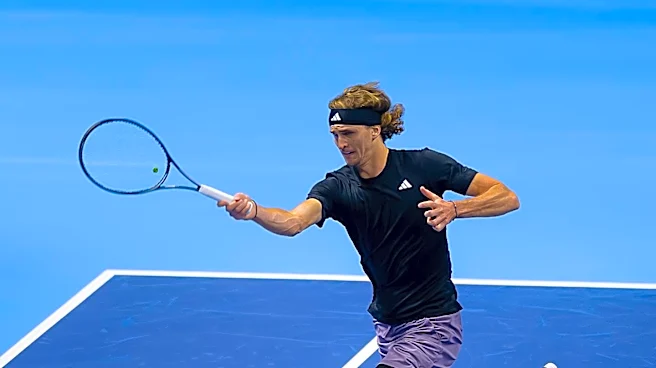
Alexander Zverev is set to become the world No. 1 in ATP rankings, a significant career milestone. However, this achievement is accompanied by a notable statistic: a poor record against top-10 players in 2026. Following his recent defeat to Alex de Minaur
in Vienna, Zverev's record against top-10 opponents stands at just three wins against nine losses for the season, resulting in an 18.1% win rate. Six of these defeats were against Jannik Sinner (five times) and Carlos Alcaraz. He also lost twice to Alex de Minaur and once to Taylor Fritz. His three victories against top-10 players were against Ben Shelton, Taylor Fritz, and Alex de Minaur. Despite this unflattering record against the sport's elite, Zverev has demonstrated consistency throughout the season, winning two Grand Slam titles and participating in all major events.
Why It's Important?
Alexander Zverev's ascent to the world No. 1 ranking despite a weak record against top-10 players highlights a unique paradox in professional tennis. While consistency across a broad range of tournaments and deep runs in Grand Slams are crucial for accumulating ranking points, the ability to defeat direct rivals at the highest level is often seen as the true measure of a top player. This situation raises questions about the ATP ranking system's emphasis on overall performance versus head-to-head dominance against elite competition. For Zverev, this statistic could fuel criticism and pressure, as fans and analysts may perceive his No. 1 ranking as less legitimate if he struggles against the very best. It also suggests that while he can consistently beat lower-ranked players, he may need to develop a more effective strategy or improve his game to consistently overcome his top rivals, which is essential for long-term dominance and Grand Slam success.
What's Next?
Alexander Zverev has two remaining opportunities in the season to improve his record against top-10 players: the Rolex Paris Masters and the ATP Finals. These tournaments, especially the ATP Finals where the season's eight best players gather, will be critical tests of his ability to perform against elite competition. A strong showing in these events, particularly with wins against top-ranked opponents, could help validate his No. 1 ranking and silence critics. Conversely, continued struggles against top-10 players could intensify scrutiny and raise doubts about his ability to maintain the top spot. His performance in these upcoming tournaments will be closely watched as he aims to solidify his position and demonstrate his capacity to consistently defeat the best players on the tour.
Beyond the Headlines
Zverev's situation brings to light a deeper discussion about the definition of 'world No. 1' in sports. Is it purely a reflection of accumulated points, or should it also signify a player's undisputed superiority over their closest rivals? This debate often arises in individual sports where rankings are based on a cumulative system. The discrepancy between Zverev's ranking and his head-to-head record against top-10 players could influence how fans and future generations perceive the significance of the No. 1 title. It also underscores the mental aspect of competition at the elite level; consistently losing to specific rivals can create psychological barriers that are difficult to overcome. This scenario could prompt discussions within the tennis community about potential adjustments to the ranking system or the criteria used to evaluate a player's true standing in the sport, moving beyond mere numerical accumulation to include qualitative measures of dominance.