





What's Happening?
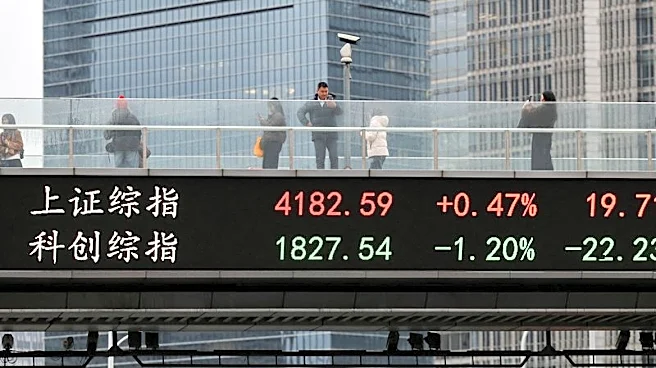
Chinese chip stocks experienced their largest single-day gain on record, with the CSI Semiconductor index climbing 17.6%, following a pledge from top policymakers in Beijing to expand the role of state-backed funds in supporting the market. The STAR index surged
14%, led by major Chinese chipmakers like CXMT, Cambricon, and SMIC. This rally occurred after a rare intraday readout from state media indicated that the State Council, chaired by Premier Li Qiang, would strengthen the role of the 'National Team'—state-backed funds—to stabilize markets and ensure ample liquidity. This explicit reference to the 'national team' in a State Council meeting readout is a first. The market rebound comes after the CSI 300 index had fallen to its lowest level since the U.S.-China tariff war escalated in 2025, and amid tightening U.S. restrictions on Chinese companies' access to advanced AI chips.
Why It's Important?
This significant market surge, driven by direct government intervention, highlights China's strategic response to ongoing U.S. efforts to restrict its access to advanced semiconductor technology. For U.S. industries, this indicates a deepening commitment by Beijing to foster domestic technological self-sufficiency, potentially accelerating the development of indigenous alternatives to U.S. chip technology. This could lead to increased competition for U.S. semiconductor firms in global markets and further complicate their access to the Chinese market. The Chinese government's prioritization of capital market performance at the highest level also signals a more proactive approach to economic management, which could influence future trade relations and investment flows between the U.S. and China. U.S. policymakers will likely view this as a direct counter-measure to their export control strategies, potentially leading to further adjustments in trade and technology policies.
What's Next?
The immediate future will likely see continued scrutiny from global investors regarding the sustainability of these state-backed market rallies and the long-term impact of China's push for semiconductor independence. Chinese chipmakers are expected to leverage this renewed government support to accelerate research, development, and manufacturing capabilities, aiming to close the technology gap with international leaders. For U.S. companies, adapting to this evolving landscape will be crucial, potentially involving diversification of supply chains, increased investment in domestic innovation, and exploring new markets. The U.S. government may consider further measures to safeguard its technological advantage, while also seeking avenues for de-escalation or managed competition in the technology sector. The interplay between U.S. restrictions and China's state-backed industrial policies will continue to shape the global technology landscape.
Beyond the Headlines
The explicit and public commitment by the Chinese government to directly intervene in its stock market, particularly in the semiconductor sector, signifies a broader strategic shift towards a more state-controlled economic model in critical industries. This approach contrasts sharply with market-driven economies and raises fundamental questions about fair competition and global trade norms. For the U.S., this development underscores the challenge of maintaining technological leadership in an era of increasing geopolitical competition. It also highlights the potential for a 'tech cold war,' where nations prioritize national security and technological sovereignty over globalized supply chains and open markets. The long-term implications could include a more fragmented global technology ecosystem, with differing standards, intellectual property regimes, and regulatory environments, posing complex challenges for multinational corporations and international cooperation.