




What's Happening?
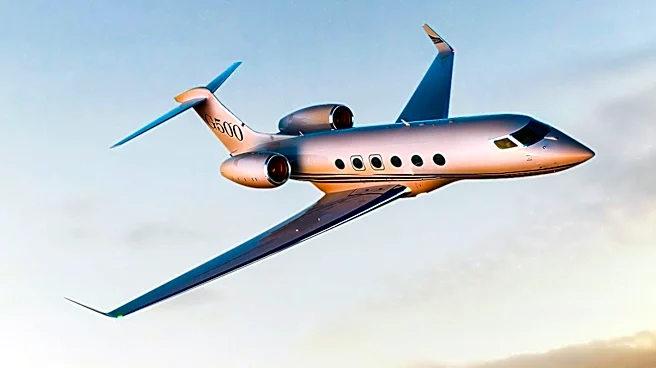
Gulfstream, in collaboration with Rolls-Royce, has conducted a series of test flights to evaluate the potential of 100% sustainable aviation fuel (SAF) in reducing contrail formation during high-altitude flights. The tests involved a G800 prototype and
a specially modified G700, both powered by twin Pearl 700 engines. These flights aimed to compare the performance of standard Jet-A, low-sulphur Jet-A, and 100% HEFA-produced SAF. The G700 served as a flying emissions measurement platform, capturing data on particulate matter and contrail-forming atmospheric characteristics at altitudes up to 50,000 feet. Preliminary results indicate a significant reduction in particulate emissions when using neat SAF, suggesting its potential to mitigate contrail formation.
Why It's Important?
The findings from these tests are significant for the aviation industry, which is under increasing pressure to reduce its environmental impact. Contrails contribute to climate change by trapping heat in the Earth's atmosphere, and reducing their formation could help mitigate aviation's non-CO2 climate impacts. The use of 100% SAF, in combination with efficient aero engines, represents a promising step towards decarbonizing aviation. This development aligns with global efforts to achieve more sustainable flight operations and could influence future regulatory changes regarding SAF usage in commercial aviation.
What's Next?
The insights gained from these tests are expected to drive further research into the environmental benefits of SAF. Gulfstream and Rolls-Royce, along with partners like the Federal Aviation Administration and NASA, will likely continue to explore the potential of SAF in reducing aviation's climate impact. Future steps may include advocating for regulatory changes to allow greater use of SAF in commercial flights, as current regulations limit its use to 50%. Continued collaboration with international aerospace and environmental organizations will be crucial in advancing these efforts.