



What's Happening?
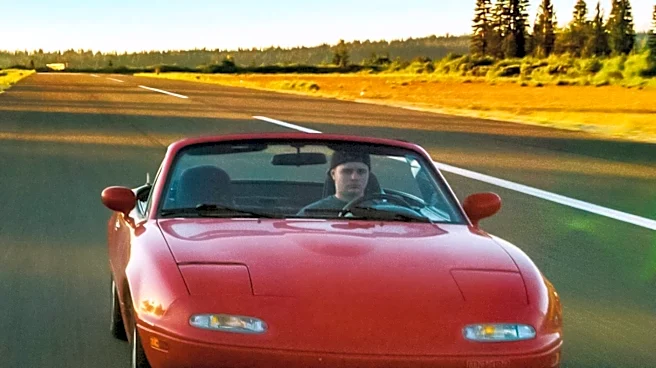
Younger generations, particularly Gen Z, are increasingly seeking out and purchasing classic Mazda Miatas, with the first-generation NA Miata being the most popular. This trend is driven by a desire for an analog driving experience, affordability compared
to newer sports cars, and the car's reputation for being fun and user-friendly. Bob Hall, a former product planner at Mazda who helped launch the original Miata, noted that young people are fascinated by the lack of modern amenities like Bluetooth or navigation, embracing the car's minimalist design. Enthusiast events, such as Miatas at the Gap, are seeing a significant proportion of first-gen Miatas, making up 30% of the over 1,800 cars present this year. Online auction sites like Bring a Trailer also report strong demand, with some well-maintained or uniquely modified Miatas fetching high prices.
Why It's Important?
The surging interest in classic Mazda Miatas among younger drivers signifies a notable shift in automotive consumer preferences and has several important implications. Economically, it boosts the market for vintage cars, particularly affordable sports models, creating a niche for restoration services, parts suppliers, and specialized dealerships. This trend also highlights a counter-cultural movement against the increasing digitalization and complexity of modern vehicles, suggesting a market for simpler, more engaging driving experiences. For the automotive industry, it could prompt manufacturers to consider producing more 'driver-focused' vehicles that prioritize engagement over technology. Socially, it fosters a community of enthusiasts who value mechanical simplicity and hands-on car culture, potentially influencing future car design and marketing strategies. This resurgence also demonstrates the enduring appeal of well-engineered, accessible sports cars, proving that classic designs can remain relevant and desirable across generations.
What's Next?
The growing demand for classic Mazda Miatas is likely to continue, potentially driving up prices for well-preserved or uniquely modified first-generation models. This trend could encourage more individuals to invest in restoring and maintaining older Miatas, further solidifying a robust aftermarket for parts and services. Automotive manufacturers might observe this trend and explore opportunities to introduce new models that offer a more 'analog' or driver-centric experience, catering to a segment of the market that values simplicity and engagement over advanced technology. Enthusiast communities and events are expected to grow, fostering a vibrant subculture around these classic vehicles. Additionally, the increased visibility of classic Miatas could inspire a broader appreciation for automotive history and design among younger consumers, potentially influencing future trends in car collecting and customization.
Beyond the Headlines
The phenomenon of young drivers embracing classic Mazda Miatas reveals deeper cultural and psychological undercurrents. In an increasingly digital and complex world, the Miata offers a tangible, unmediated experience—a form of 'digital detox' on wheels. Its lack of modern tech forces drivers to engage more directly with the act of driving, fostering a sense of control and connection often lost in highly automated vehicles. This preference for simplicity and authenticity can be seen as a broader generational response to information overload and the pervasive influence of screens. Ethically, it raises questions about planned obsolescence in modern manufacturing and the environmental impact of constantly replacing vehicles versus maintaining older, more repairable ones. Culturally, it represents a nostalgic yearning for a perceived simpler time, where the joy of a machine was in its mechanical purity rather than its computational power, influencing not just car culture but potentially other consumer choices as well.