



What's Happening?
General Motors (GM) is re-evaluating its electrification strategy by significantly investing in hybrid vehicle production. The company plans to introduce hybrid versions of its Chevrolet Traverse, GMC Acadia, and Buick Enclave models. This move comes
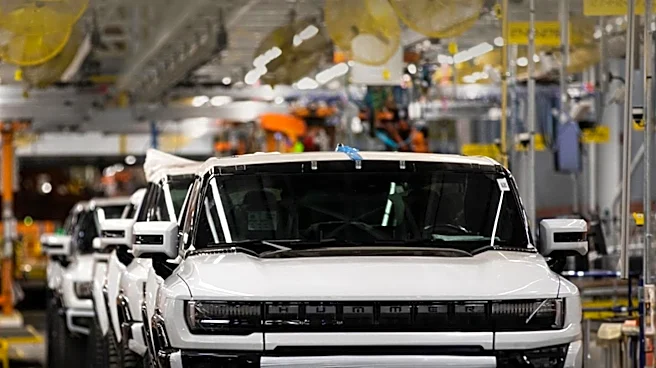
as GM acknowledges the need for a broader electrified offering beyond purely battery-electric vehicles. CEO Mary Barra has emphasized that hybrids will cover multiple segments and will not require additional engineering or capital expenditure beyond existing plans. To support this shift, GM intends to redirect $500 million in federal funding, initially allocated for electric vehicle manufacturing, towards hybrid production in Michigan. Additionally, the automaker will invest approximately $1.25 billion in its Lansing Delta Township (LDT) factory to accommodate hybrid vehicle manufacturing. The LDT plant, designed as GM's first green factory, specializes in large crossovers and operates as a complete production site, handling metal stamping and body welding. While GM has confirmed the investment, specific hybrid models for LDT and their launch schedule remain undisclosed.
Why It's Important?
This strategic pivot by General Motors holds significant implications for the U.S. automotive industry and consumers. For years, GM has heavily promoted battery-electric vehicles as the future, but this shift indicates a recognition of market demand for diverse powertrain options. By introducing hybrids, GM aims to capture a segment of consumers who may be hesitant to fully transition to EVs due to range anxiety, charging infrastructure concerns, or higher upfront costs. This could lead to increased sales and market share for GM, especially in the popular SUV segment where fuel efficiency is a key concern for families. The substantial investment in the Lansing Delta Township factory underscores GM's commitment to U.S. manufacturing and job creation in Michigan. The redirection of federal funding also highlights a potential recalibration of government incentives to support a wider array of green vehicle technologies. This move could also intensify competition with foreign automakers, particularly Japanese and Korean brands, which have historically dominated the hybrid market in the U.S.
What's Next?
General Motors is expected to proceed with its planned investment of $1.25 billion in the Lansing Delta Township plant to prepare for hybrid vehicle production. The company will also likely finalize the redirection of $500 million in federal funding for this purpose. Consumers can anticipate the eventual launch of hybrid versions of the Chevrolet Traverse, GMC Acadia, and Buick Enclave, though specific timelines are yet to be announced. This shift could influence other U.S. automakers to re-evaluate their own electrification strategies and potentially increase their focus on hybrid offerings. The move may also lead to discussions regarding the allocation of federal incentives for green vehicle technologies, potentially broadening support beyond solely battery-electric vehicles. Dealers, who have reportedly been requesting hybrids for years, are expected to welcome this development, which could provide them with more competitive products to offer customers.
Beyond the Headlines
GM's decision to embrace hybrids reflects a broader industry trend of adapting to evolving consumer preferences and technological realities. While the long-term vision for an all-electric future remains, this move suggests a more pragmatic approach to the transition, acknowledging that a significant portion of the market still seeks internal combustion engine components. This could also spark a debate about the optimal path to decarbonization in the automotive sector, questioning whether a singular focus on EVs is the most effective strategy. Furthermore, the emphasis on hybrids, which often do not require external charging, addresses infrastructure limitations that have been a barrier to widespread EV adoption. This strategic adjustment by a major U.S. automaker like GM could influence public policy and investment in charging infrastructure, potentially leading to a more diversified approach to supporting sustainable transportation solutions.