




What's Happening?
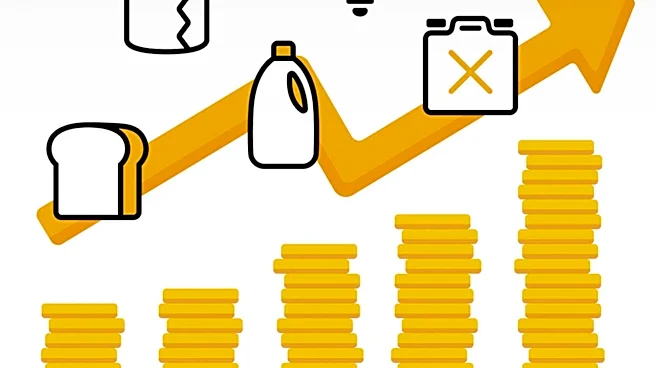
Numerator, a consumer data and technology company, released its October 2026 Consumer Goods Price Index (CGPI), indicating that inflation for everyday goods in the U.S. has reaccelerated. Prices for everyday household purchases increased by 0.6% in October,
following a 0.7% rise in September. This marks a reversal after decreases in August and July. Year-over-year, prices for everyday goods are up 2.7% compared to October of the previous year, an acceleration from the 2.1% rate observed in September. Since January 2018, prices for these goods have cumulatively increased by 34.8%. The report also highlights that consumer concern about rising prices has reached a record high, with 42.2% of U.S. consumers identifying it as their top concern for the coming year, surpassing the previous record of 40.5% from August 2026. Paul Stanley, Senior Economist at Numerator, noted that prices are nearly 35% higher than in 2018, indicating persistent pressure on household budgets.
Why It's Important?
The reacceleration of inflation in everyday consumer goods has significant implications for U.S. households and the broader economy. Rising prices directly impact household budgets, reducing purchasing power and potentially leading to shifts in consumer spending habits. The record-high consumer concern about inflation suggests a growing lack of confidence in economic stability, which could influence future spending and saving behaviors. Low-income and Gen Z consumers are particularly affected, experiencing higher inflation rates for everyday household goods (36.7% and 41.3% respectively since January 2018, compared to the 34.8% national average). This disparity is partly due to their higher spending on quick-service restaurants, where prices have surged by 55.4% since January 2018. The widening gap in inflation rates across different demographic groups could exacerbate economic inequality and create varied financial pressures across the population.
What's Next?
The continued acceleration of consumer goods inflation suggests that U.S. households will likely face ongoing financial strain in the near future. Policymakers and economic analysts will closely monitor subsequent inflation reports to determine if this trend persists or if it is a temporary fluctuation. If inflation continues to rise, it could prompt further discussions about monetary policy adjustments by the Federal Reserve, potentially impacting interest rates and credit markets. Businesses, particularly those in the consumer goods sector, may need to adjust pricing strategies, supply chain management, and inventory levels in response to changing consumer demand and rising input costs. Consumers, especially those in vulnerable demographics, may increasingly seek out value options, alter their purchasing patterns, and prioritize essential goods over discretionary spending to manage their budgets.
Beyond the Headlines
The sustained increase in consumer goods prices, particularly its disproportionate impact on younger and lower-income demographics, points to deeper societal and economic challenges. The data from Numerator suggests a growing divergence in economic experiences across different consumer segments, which could lead to increased social stratification and economic stress for a significant portion of the population. The reliance of certain groups on quick-service restaurants, which have seen substantial price hikes, highlights how lifestyle and economic circumstances intersect with inflationary pressures. This situation could also fuel broader debates about wage growth, income inequality, and the effectiveness of current economic policies in protecting vulnerable households from inflationary shocks. The long-term implications could include shifts in consumer brand loyalty, increased demand for discount retailers, and a re-evaluation of household budgeting strategies across the nation.