



What's Happening?
K2 Space, a U.S. company specializing in large, high-power satellites, has successfully closed a $500 million Series D funding round, elevating its valuation to $6.8 billion. This latest investment, led by Kleiner Perkins and ICONIQ, with participation
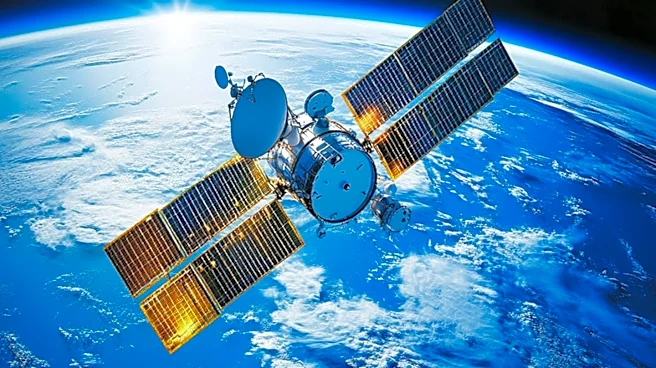
from CapitalG, Lightspeed, and others, brings K2 Space's total capital raised to over $1 billion. The company has also secured more than $1 billion in signed commercial and government contracts. K2 Space is focused on scaling its production capabilities, with plans to manufacture up to 100 large satellites annually at its 180,000 sq ft factory in Torrance, California. The company's vertical integration strategy, building over 85% of its platform in-house, is central to its ability to deliver high-power, high-mass satellites efficiently. K2 Space is currently involved in significant projects, including providing 30 satellites for SES's 'meoSphere' network, contributing to the Golden Dome for America space-based interceptor missile defense program, and serving as the bus provider for the Space Force's Protected Tactical Satcom-Global program.
Why It's Important?
This significant funding and valuation underscore a growing confidence in the U.S. space economy and K2 Space's approach to satellite technology. The development of large, high-power satellites is crucial for advancing various U.S. strategic interests, including national security, commercial communications, and scientific exploration. K2 Space's involvement in programs like the Golden Dome for America and the Space Force's Protected Tactical Satcom-Global highlights its role in bolstering U.S. defense capabilities in space, particularly in missile defense and secure communications. The ability to produce up to 100 large satellites per year signifies a substantial increase in domestic manufacturing capacity for critical space infrastructure, potentially reducing reliance on foreign suppliers and strengthening the U.S. industrial base. This investment also signals a broader trend towards more powerful and capable satellites, which can support more complex missions and data processing in orbit, impacting industries from telecommunications to Earth observation and beyond.
What's Next?
K2 Space plans to introduce its 100kW Giga-class satellite in the second half of 2028, which is expected to be a foundational platform for deploying significant computing power in orbit. Over the next 24 to 48 months, the company will prioritize delivering large constellation orders for its customers' ambitious programs. K2 Space's next mission, Trinity, is scheduled to launch multiple satellites in the second quarter of 2027. The company will continue to invest in research and development to enhance its large platforms, aiming to maintain a competitive advantage in the satellite market. This ongoing development and deployment will likely solidify K2 Space's position as a key player in providing advanced satellite solutions for both commercial and government sectors, further shaping the future of the U.S. space industry.
Beyond the Headlines
The success of K2 Space reflects a broader shift in the U.S. space industry towards private sector innovation and vertical integration to meet complex demands. The emphasis on 'power determines capability' in orbit suggests a strategic move towards satellites that can host more advanced payloads and perform more sophisticated tasks, potentially leading to breakthroughs in data processing, communication speeds, and remote sensing. The company's deep involvement in national security programs raises questions about the increasing convergence of commercial space capabilities with defense objectives, blurring the lines between civilian and military applications of space technology. This trend could lead to new ethical and regulatory considerations regarding the dual-use nature of advanced satellite systems and the role of private companies in national defense infrastructure. Furthermore, the rapid scaling of satellite production could have long-term environmental implications, including concerns about space debris and orbital congestion, which will require careful management and international cooperation.