



What's Happening?
Mitsui Chemicals has announced a proposed acquisition of JSR Corporation, valued at approximately ¥1.84 trillion (around US$11.6 billion). This transaction, announced on November 9, 2026, is one of Japan's largest in the chemical industry and aims to
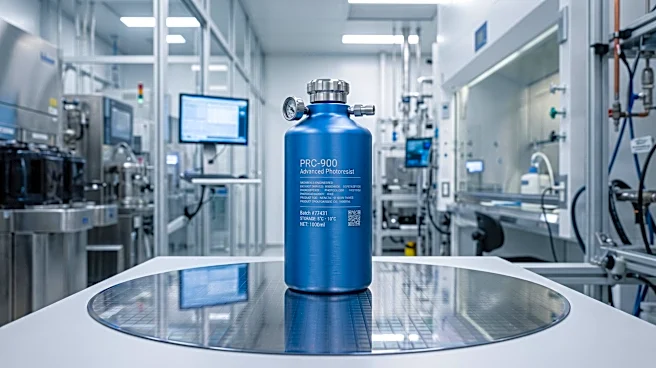
bolster Mitsui Chemicals' position in the global semiconductor materials market. The deal involves Mitsui Chemicals and the Development Bank of Japan (DBJ) acquiring JSR from investment funds managed by JIC Capital. JSR is a key player in advanced materials, particularly semiconductor photoresists, which are crucial for transferring intricate circuit patterns onto silicon wafers during chip manufacturing. The acquisition is a central component of Mitsui Chemicals' VISION 2030 strategy, focusing on strengthening its higher-value specialty chemicals businesses and integrating JSR into its Information and Communications Technology (ICT) Solutions business. The completion is targeted for the second half of the fiscal year ending March 2028, pending regulatory approvals.
Why It's Important?
This acquisition is strategically significant for the U.S. and global technology supply chain, as it aims to secure critical advanced materials essential for semiconductor production. The U.S. relies heavily on a global network of suppliers for advanced chips, and consolidation in the materials sector can impact supply stability and innovation. By combining Mitsui Chemicals' specialty materials with JSR's expertise in photoresists, the enlarged entity could become a more dominant supplier to international semiconductor manufacturers, including those serving the U.S. market. This move reflects a broader industrial strategy where companies are competing to control the foundational technologies and materials that underpin the entire production ecosystem, particularly for AI, high-performance computing, and next-generation electronics. The deal could influence the competitive landscape for semiconductor materials, potentially leading to stronger competition or more integrated solutions for U.S. chipmakers.
What's Next?
The acquisition's completion is contingent on obtaining necessary competition-law and foreign-investment approvals, which will be a key focus in the coming months. Mitsui Chemicals plans to finance the acquisition primarily through a ¥1.64 trillion bridge loan, with DBJ contributing ¥200 billion. The company will need to manage this significant financial commitment and transition to more permanent funding arrangements. Investors and industry observers will closely monitor Mitsui Chemicals' ability to integrate JSR's operations, research capabilities, and customer relationships. The success of the acquisition will also depend on market conditions, customer demand, and the ability to translate technological advantages into commercial growth, with a target of ¥40 billion in additional annual profit by fiscal 2035. Potential divestments of non-core businesses by JSR are also anticipated as part of the portfolio restructuring.
Beyond the Headlines
This mega-deal highlights a deeper trend in the global technology landscape: the increasing strategic importance of advanced materials in the semiconductor industry. As the U.S. and other nations prioritize domestic chip manufacturing and supply chain resilience, control over specialized materials like photoresists becomes a critical factor in national economic security and technological independence. The acquisition could trigger further consolidation or strategic partnerships within the global semiconductor materials sector, as other companies seek to secure their positions. It also underscores the ethical and legal considerations surrounding market concentration in essential technology components, potentially raising questions about fair competition and access to critical inputs for smaller players or new entrants in the semiconductor space. The long-term implications could include shifts in global manufacturing power and increased competition for talent and intellectual property in advanced materials science.