






What's Happening?
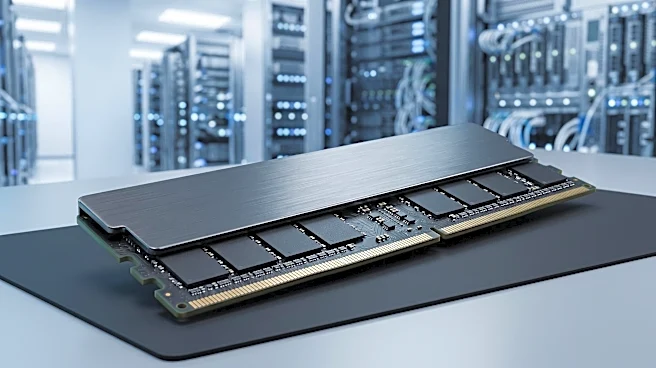
Micron Technology, a prominent leader in semiconductor memory and storage solutions, has announced a significant breakthrough in memory innovation. The company successfully demonstrated the world's first 512GB DDR5 module across multiple server platforms.
This achievement underscores Micron's continued leadership in developing high-capacity server memory. The new 512GB DDR5 module is designed to support highly demanding workloads, including artificial intelligence (AI), advanced analytics, in-memory databases, and simulation-intensive applications. By providing greater efficiency, this development allows for larger datasets to be processed closer to the compute engines that require them, thereby enhancing overall system performance and data handling capabilities. Micron's focus remains on setting new standards for memory technology, delivering ultra-dense and high-performance solutions for the evolving needs of data centers and advanced computing environments.
Why It's Important?
This advancement by Micron Technology is crucial for the U.S. technology sector and industries heavily reliant on data processing. The development of a 512GB DDR5 module signifies a leap forward in server memory capacity and efficiency, directly impacting the performance of AI and high-performance computing (HPC) applications. Businesses and research institutions engaged in large-scale data analytics, machine learning, and complex simulations stand to gain significantly from this technology, as it enables faster processing of massive datasets. This can lead to quicker insights, more accurate models, and accelerated innovation across various fields. For the U.S. economy, this innovation reinforces the nation's position in semiconductor technology and could drive further investment in data centers and AI infrastructure. Companies that can leverage this higher-capacity memory will gain a competitive edge, while those unable to upgrade their systems might face limitations in processing power and data throughput, potentially affecting their operational efficiency and market standing.
What's Next?
Following this successful demonstration, the next steps for Micron Technology will likely involve further optimization, testing, and eventual commercialization of the 512GB DDR5 modules. We can anticipate partnerships with server manufacturers and cloud service providers to integrate these high-capacity modules into next-generation server platforms. The broader industry will be watching for announcements regarding availability and pricing, which will influence adoption rates. Competitors in the memory market will likely accelerate their own research and development efforts to match or surpass Micron's achievement, fostering continued innovation in the semiconductor space. Additionally, the increased memory capacity will enable the development of even more sophisticated AI models and data-intensive applications, pushing the boundaries of what is currently possible in computing. This could lead to new software and hardware solutions designed to fully exploit the capabilities of these advanced memory modules.
Beyond the Headlines
Beyond the immediate technical implications, Micron's achievement highlights a broader trend in the technology industry: the relentless pursuit of higher performance and efficiency to meet the escalating demands of data. The ability to handle larger datasets closer to compute engines has profound implications for data privacy and security, as it can reduce the need for data to be moved across networks, potentially lowering exposure risks. Ethically, this increased processing power raises questions about the responsible development and deployment of AI, particularly concerning bias in algorithms and the potential for misuse. Culturally, as AI becomes more powerful and integrated into daily life, the underlying hardware innovations like Micron's DDR5 modules are foundational to this transformation, shaping how society interacts with technology and information. This continuous advancement in memory technology is not just about speed and capacity; it's about enabling a future where data-driven insights become more accessible and impactful across all sectors.