



What's Happening?
Rivian CEO RJ Scaringe recently discussed his company's analysis of a Chinese Xiaomi SU7 electric vehicle, which Rivian engineers disassembled to understand its construction and technology. Scaringe described the Xiaomi SU7 as a 'really well-executed,
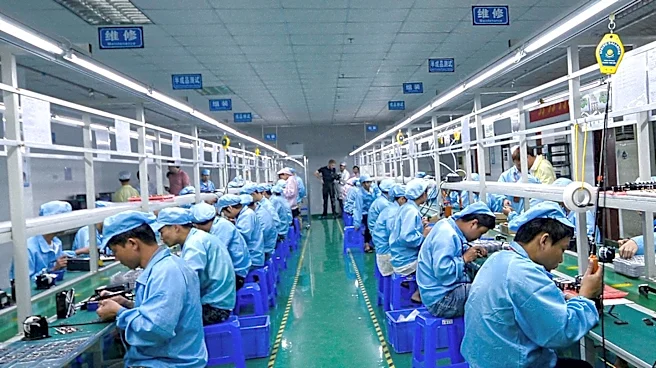
heavily vertically integrated technology platform' with 'nicely done' in-house tech. Despite the praise for its execution, Scaringe stated that the teardown revealed 'nothing groundbreaking' in terms of technology that would explain the car's popularity. Instead, he attributed the success of Chinese EVs, including the Xiaomi SU7, to factors such as lower labor costs and substantial government support in China. This support includes instances where the Chinese government pays companies to construct EV manufacturing plants, a level of subsidy not seen in the U.S.
Why It's Important?
This insight from Rivian's CEO highlights the competitive landscape facing U.S. electric vehicle manufacturers. The ability of Chinese EV makers to achieve lower costs due to government subsidies and reduced labor expenses presents a significant challenge to companies like Rivian and Ford, whose CEO Jim Farley has also expressed interest in Chinese cars. The lack of 'groundbreaking' technology in the Xiaomi SU7, as noted by Scaringe, suggests that the competitive advantage of Chinese EVs is primarily economic and governmental rather than technological innovation. This could pressure U.S. policymakers to consider increased support for domestic EV manufacturing to level the playing field, or it could lead to increased calls for tariffs or other trade barriers to protect U.S. automakers from what could be perceived as unfair competition.
What's Next?
The findings from Rivian's teardown could influence strategic decisions within the U.S. automotive industry. American EV manufacturers may intensify their efforts to reduce production costs and enhance vertical integration to compete more effectively with Chinese imports. This could also prompt further discussions within the U.S. government regarding industrial policy, subsidies for domestic manufacturing, and trade relations with China concerning the automotive sector. Ford CEO Jim Farley's interest in Chinese cars suggests that U.S. automakers are closely monitoring the potential entry of these vehicles into the U.S. market within the next five to ten years. This could lead to increased collaboration or competition, depending on market dynamics and regulatory frameworks.
Beyond the Headlines
The teardown of the Xiaomi SU7 by Rivian underscores a broader geopolitical and economic competition in the global automotive industry, particularly in the rapidly evolving EV sector. It highlights the different approaches to industrial development between China and the U.S., with China's state-backed industrial policies enabling rapid growth and cost advantages. This situation could lead to a re-evaluation of free-market principles versus strategic industrial planning in the U.S. The implications extend to national security, as dominance in critical technologies like EVs can confer significant economic and strategic advantages. Furthermore, the insights gained from such competitive analyses could drive innovation in manufacturing processes and supply chain management within the U.S., as companies strive to match the cost efficiencies demonstrated by their Chinese counterparts, potentially leading to long-term shifts in global automotive production strategies.