





What's Happening?
China has introduced a comprehensive 19-measure policy package aimed at accelerating what it terms 'new quality productive forces.' This state-led initiative, outlined by the Communist Party Central Committee and the State Council, seeks to boost productivity
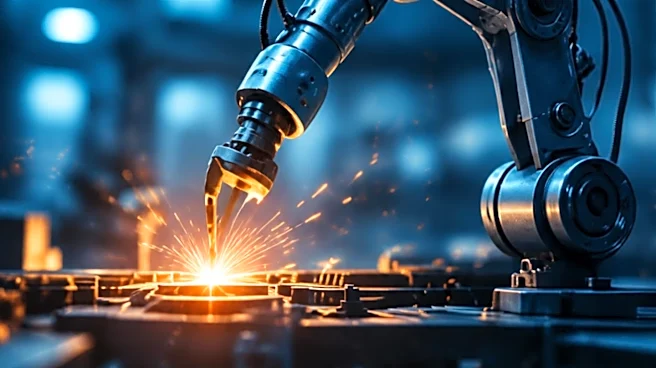
through innovation, advanced manufacturing, and artificial intelligence (AI). The guidelines serve as a roadmap to redirect capital, talent, and policy support towards sectors deemed crucial for China's next phase of growth, moving away from reliance on a weaker property cycle and addressing overcapacity in older industries. Key priorities include strengthening scientific and technological innovation, integrating science and industry, institutional reform, and talent development. The plan emphasizes faster breakthroughs in core technologies, increased support for national laboratories and research universities, and a greater role for enterprises, including technology-heavy small and mid-sized firms, in major national projects.
Why It's Important?
This policy package is significant as it signals a strategic shift in China's economic growth model, moving from quantity to quality. By prioritizing AI and advanced manufacturing, China aims to enhance its global competitiveness and reduce its vulnerability to external economic pressures. For U.S. industries, this could mean intensified competition in high-tech sectors, potentially impacting global supply chains and market dynamics. The emphasis on self-reliance and breakthroughs in core technologies could lead to reduced reliance on foreign technology, affecting U.S. tech companies with significant market presence in China. Conversely, the encouragement of foreign venture capital and international standards bodies to engage in China presents mixed opportunities, as foreign firms may face increased pressure to localize or transfer know-how for market access. This strategic pivot will likely influence global investment flows and technological development trajectories, with potential long-term implications for U.S. economic and technological leadership.
What's Next?
The full implementation of the 'AI Plus' initiative, a core component of the new policy, will involve widening AI application across various industries and establishing monitoring and risk systems to ensure the technology remains 'safe, reliable and controllable.' This suggests continued policy support for domestic AI model makers, industrial software, automation, semiconductors, cloud infrastructure, and data-center supply chains. Investors will be closely watching whether this policy support translates into stronger profitability for favored industries rather than just increased investment. The guidelines are integrated into China's broader five-year planning framework, with the 15th Five-Year Plan (2026-2030) making 'new quality productive forces' a strategic task with 28 major projects assigned to this goal. This indicates a sustained, long-term commitment to this economic transformation, guiding where private capital, foreign capital, and local governments are expected to direct spending in the coming years.
Beyond the Headlines
Beyond the immediate economic and industrial implications, China's new policy package reflects a deeper strategic ambition to reshape its global standing through technological prowess. The focus on 'new quality productive forces' and self-reliance in core technologies can be seen as a response to ongoing geopolitical tensions and efforts by some nations to limit China's access to advanced technologies. This approach could accelerate the decoupling of certain technological ecosystems, leading to parallel development paths and potentially divergent global standards. The emphasis on 'controllable AI' also raises ethical and governance questions regarding the balance between innovation and state control, which could influence global debates on AI regulation. Ultimately, this policy package is not just about economic growth but about securing China's technological sovereignty and influence in the 21st century, with profound implications for the global technological landscape and international relations.