





What's Happening?
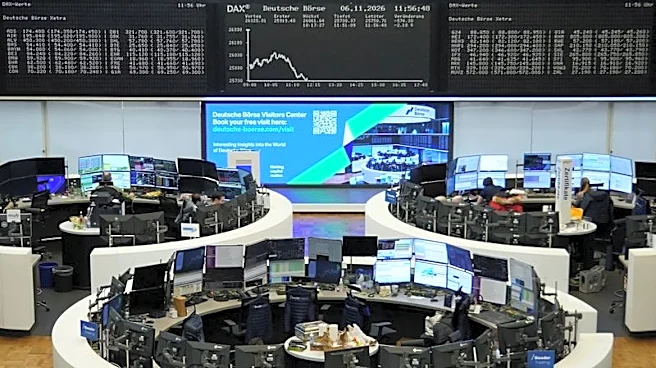
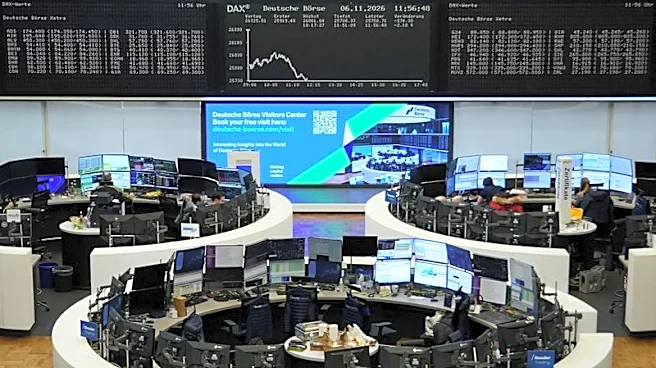
European stock markets have achieved new record highs, with the STOXX 600 index rising 0.4% to 665.61 points. This surge is primarily attributed to robust corporate earnings reports and a decrease in energy prices. The STOXX 600 has seen an almost 5%
gain this quarter, surpassing the performance of the U.S. S&P 500, which experienced a 0.4% decline over the same period. Companies within the STOXX 600 are projected to report approximately 25% quarterly profit growth, marking the strongest increase in four years. Significant contributions have come from energy companies, alongside gains in healthcare, industrials, consumer goods, and financial services sectors. Several major companies, including Siemens and Merck, have revised their outlooks upwards following positive results. Additionally, falling oil prices, with crude moving below $100 a barrel due to easing Middle East tensions, have provided further support by potentially reducing operating expenses and inflationary pressures for European businesses.
Why It's Important?
The strong performance of European equities holds significance for U.S. investors and the global economy. The outperformance of the STOXX 600 compared to the U.S. S&P 500 indicates a potential shift in investment preferences, with investors re-evaluating highly valued technology stocks in the U.S. and Asia. This reallocation of capital towards established European businesses across various sectors could impact U.S. market dynamics and investment strategies. For U.S. companies with significant European operations or exposure, the improved economic conditions and corporate profitability in Europe could translate into better earnings and growth prospects. Conversely, U.S. technology companies might face increased competition for investment capital as European markets become more attractive. The lower energy prices, while directly benefiting European businesses, also contribute to a more stable global economic environment, which can indirectly support U.S. economic stability by reducing inflationary pressures and improving supply chain costs.
What's Next?
The current momentum in European stock markets suggests continued investor interest in the region, particularly in sectors demonstrating strong earnings growth and those benefiting from lower energy costs. Companies like Siemens and Merck, having already raised their financial outlooks, may see sustained positive sentiment. The reassessment of highly valued U.S. and Asian technology stocks could lead to further capital flows into European industrial, healthcare, consumer, and financial sectors. However, the performance remains mixed, with luxury goods and automotive stocks experiencing declines due to weaker demand in China and increased competition from Chinese electric vehicle manufacturers. Future developments will likely depend on the persistence of strong corporate earnings, the stability of energy prices, and the evolving global economic landscape, including any shifts in consumer demand in key markets like China.
Beyond the Headlines
The divergence in performance between European and U.S. stock markets highlights a broader recalibration of global investment strategies. The shift away from highly valued U.S. and Asian technology stocks towards more traditional European sectors like industrials and healthcare could signal a move towards value investing and a more diversified global portfolio approach. This trend might also reflect a growing recognition of the resilience and fundamental strength of European economies, despite previous concerns about regional stability. The impact of lower oil prices extends beyond immediate corporate profitability, potentially influencing broader geopolitical stability and energy policy discussions. Furthermore, the mixed performance within Europe, with certain sectors struggling, underscores the importance of selective investment and a nuanced understanding of regional economic drivers, rather than a blanket approach to European markets.