





What's Happening?
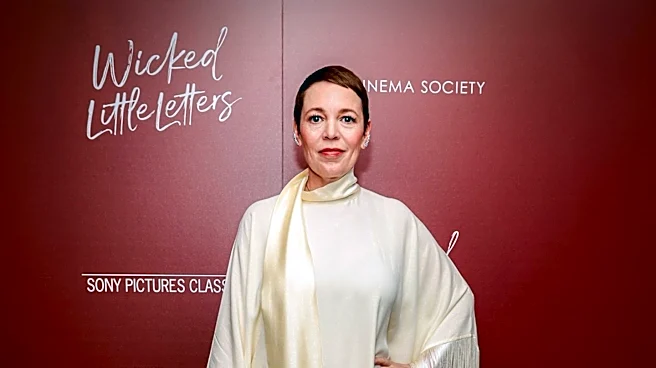
The film 'Wicker,' starring Olivia Colman and Alexander Skarsgård, is being reviewed as a unique cinematic experience that delves into human emotions despite its unusual premise. The story centers on a lonely fisherwoman, played by Olivia Colman, who
commissions a basket maker, played by Peter Dinklage, to create a husband out of wood. This 'wicker man,' portrayed by Alexander Skarsgård, becomes a perfect partner, leading to jealousy and annoyance among the other villagers. The review highlights that while the film's trailer might suggest a bizarre, sexually charged fairytale, the movie quickly transcends this initial impression to focus on everyday human reactions and emotions such as jealousy, love, envy, hatred, manipulation, disappointment, and self-worth. The special effects are praised for their seamless integration, making it easy for viewers to forget that Skarsgård's character is made of wicker.
Why It's Important?
The film 'Wicker' represents a significant artistic endeavor that challenges conventional storytelling by using a fantastical element to explore deeply human themes. Its critical reception, particularly the emphasis on emotional depth over its initial quirky premise, suggests a potential shift in audience and critical appreciation for films that blend genres and offer nuanced character studies. For the U.S. film industry, this could encourage more experimental narratives and a greater focus on character-driven plots, even within seemingly unusual frameworks. The performances of acclaimed actors like Olivia Colman, Alexander Skarsgård, and Peter Dinklage lend credibility to the project, demonstrating that strong acting can elevate even the most unconventional stories. This approach could influence future film productions and the types of stories that receive funding and distribution in the U.S. market.
What's Next?
With 'Wicker' now released in cinemas, its performance and critical reception will be closely monitored. Positive reviews, particularly those highlighting its emotional depth and unique narrative, could contribute to strong word-of-mouth and box office success. The film's unconventional nature might also position it as a contender for independent film awards or categories that recognize innovative storytelling. The success of 'Wicker' could pave the way for more films that dare to explore complex human emotions through imaginative and non-traditional lenses. Filmmakers and studios in the U.S. might take cues from its approach, potentially leading to a broader range of creative projects being greenlit in the future.
Beyond the Headlines
Beyond its immediate cinematic impact, 'Wicker' touches upon deeper societal and psychological implications. The narrative's exploration of a 'perfect' partner and the subsequent reactions of jealousy and envy among villagers can be seen as a commentary on societal expectations, relationships, and the human tendency to compare and covet. The film's ability to make viewers forget the fantastical element of a 'wicker man' and focus on the emotional core speaks to the power of storytelling to transcend literal interpretations and connect with universal human experiences. This could spark discussions about what truly constitutes a fulfilling relationship, the nature of perfection, and the impact of societal pressures on individual happiness. The film's unique blend of fantasy and realism offers a rich ground for ethical and cultural analysis, reflecting on how we perceive and react to the 'other' or the 'unconventional' in our lives.