






What's Happening?
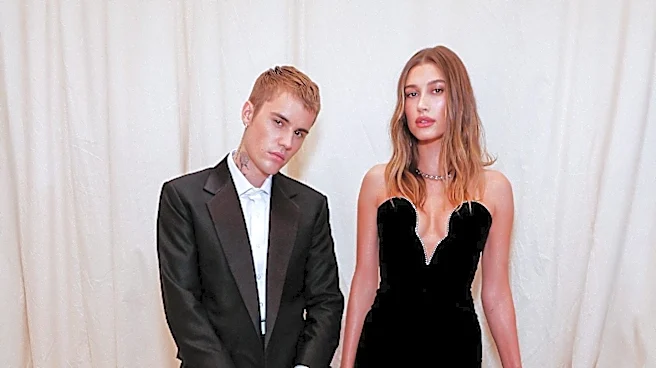
During an appearance on the French talk show 'Quotidien' on September 30, Hailey Bieber stated that her husband, Justin Bieber, is French. This declaration, made while she was promoting her beauty brand Rhode's expansion into France, surprised the host,
Yann Barthès. Despite Barthès pointing out that Justin Bieber is Canadian, Hailey Bieber insisted, explaining that while he is from Canada, his family is French. She was unable to specify the region of France his family originated from. Justin Bieber was born in London, Ontario, Canada, and has consistently been identified as Canadian throughout his career. However, his mother, Pattie Mallette, does have French-Canadian ancestry, with family roots in Quebec and Acadian communities.
Why It's Important?
This incident highlights a common cultural misunderstanding regarding nationality versus ancestry, particularly in the context of American perceptions of heritage. While many Americans might refer to distant ancestral ties as their nationality, in countries like France, 'French' typically denotes citizenship or being from France. The exchange on French television, where the host was visibly confused, underscores this distinction. For Hailey Bieber, the comment may have been an attempt to connect personally with the French audience during a business trip, but it inadvertently sparked online debate and jokes about the difference between being French by nationality and having French-Canadian heritage. This situation also touches on the broader implications of public figures' statements and how they can be interpreted differently across cultures, potentially leading to miscommunication or even perceived gaffes.
What's Next?
The immediate aftermath of Hailey Bieber's comments has primarily been online discussion and media coverage, with many viewers and social media users debating the nuances of French versus French-Canadian identity. It is unlikely to have significant long-term consequences for either Hailey or Justin Bieber, beyond being a memorable moment in their public appearances. However, it serves as a minor case study in cross-cultural communication for public figures and brands. Future public appearances by Hailey Bieber, especially in international contexts, might see her or her team being more precise in their language regarding cultural heritage to avoid similar misunderstandings. The incident may also prompt further discussions online about how different nationalities perceive and articulate their ancestral backgrounds.
Beyond the Headlines
The incident delves into the complex interplay of identity, nationality, and ancestry, particularly for individuals with diverse heritage. For many in North America, especially the U.S. and Canada, identifying with ancestral roots (e.g., 'Irish-American,' 'French-Canadian') is a common way to express cultural identity. However, in many European nations, 'nationality' is more strictly tied to citizenship and place of birth. Hailey Bieber's assertion, while perhaps well-intentioned to show a connection to France, inadvertently exposed this cultural gap. It also highlights the challenges public figures face in navigating global media landscapes, where a statement made with one cultural understanding can be received very differently by another. The online reaction, ranging from amusement to mild criticism, reflects a broader societal conversation about cultural sensitivity and the accurate representation of national and ethnic identities.