
What's Happening?
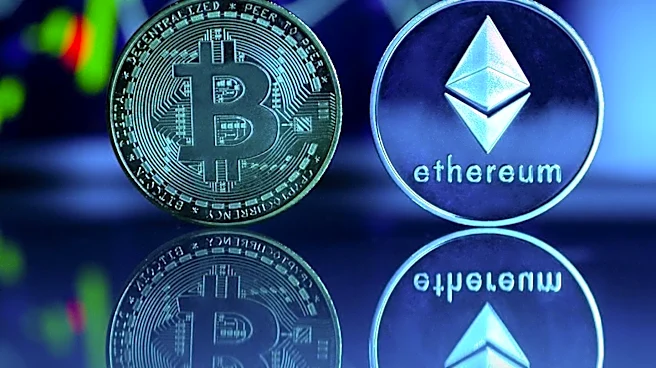
The popular notion of 'Uptober,' suggesting October is a reliably strong month for cryptocurrency, has been re-evaluated by analyzing the performance of Bitcoin, Ethereum, Solana, and XRP over the past
nine years. For Bitcoin, October has indeed shown strength, with seven out of nine years closing higher than they opened, and a median gain of 10.9%. However, this strength does not consistently extend to the entire fourth quarter (October to December), where only five of nine years for Bitcoin ended in the black, with the median shrinking to 5.4%. Ethereum also showed six strong Octobers but a modest median gain of 0.7% for the month, though its full fourth-quarter median was a stronger 22.5%. XRP, conversely, did not support the 'Uptober' thesis, with only three of nine Octobers and fourth quarters ending positively, and negative median returns. Solana, with only five quarters of history, showed highly volatile results, making seasonal statements difficult.
Why It's Important?
This analysis is important for U.S. investors as it challenges a widely held belief within the cryptocurrency community, encouraging a more data-driven approach to investment decisions. Relying solely on seasonal slogans like 'Uptober' can be misleading, as historical averages can be skewed by outlier years, as seen with Bitcoin's average fourth-quarter return of 44.7% being heavily influenced by two exceptional years. The study emphasizes that while October might show a tendency for positive returns for Bitcoin, this does not guarantee similar performance for the entire quarter or for other cryptocurrencies. For investors, understanding the nuances of seasonality, including hit rates and medians, is crucial for managing expectations and making informed choices, especially when considering the high volatility inherent in the crypto market. It also highlights the varying performance across different digital assets, suggesting that a blanket approach to 'crypto seasonality' is not effective.
What's Next?
Investors are advised to look beyond generalized slogans and examine specific data for each cryptocurrency, focusing on hit rates and median returns rather than averages. For those considering investments based on quarterly trends, the analysis suggests that a 'coin-flip rate' for Bitcoin's full fourth-quarter performance, with only a slight tilt to the upside, is a more realistic expectation. The study also implicitly warns against making investment decisions based on short-term historical patterns, especially for newer cryptocurrencies like Solana with limited data. Instead, a strategy of regular, fixed-amount investments (dollar-cost averaging) is suggested as a way to mitigate the risks associated with market timing based on seasonality. Furthermore, for German investors, tax implications related to holding periods are highlighted as a more concrete factor than seasonal trends, underscoring the importance of understanding local regulations.
Beyond the Headlines
The re-evaluation of 'Uptober' reflects a growing maturity in cryptocurrency market analysis, moving from anecdotal observations to more rigorous statistical examination. This shift is crucial for the long-term credibility and stability of the crypto market, as it encourages investors to adopt more sophisticated analytical tools. The findings also underscore the inherent differences between various cryptocurrencies; what holds true for Bitcoin may not apply to Ethereum or XRP, highlighting the need for asset-specific research. This deeper understanding of market dynamics can help professional and retail investors alike to develop more robust strategies, reducing reliance on speculative narratives and fostering a more informed investment environment. Ultimately, it contributes to the ongoing process of integrating cryptocurrency into mainstream financial discourse, where data and evidence-based analysis are paramount.