





What's Happening?
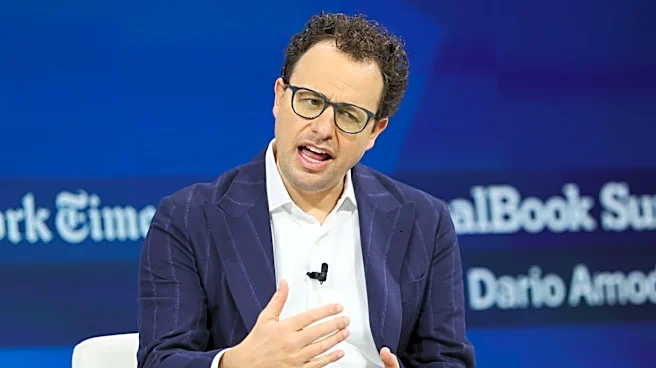
Max Jaderberg, President of Isomorphic Labs, recently appeared on 'Squawk Box' to discuss the company's significant advancements in designing drugs using artificial intelligence. Isomorphic Labs has successfully raised over $5 billion in its latest funding
round, marking a substantial investment in the AI-driven pharmaceutical sector. This capital infusion is earmarked to propel the company's drug candidates from the research and development phase towards clinical trials. The company's strategy leverages AI to accelerate the drug discovery process, aiming to identify and develop novel therapeutic compounds more efficiently than traditional methods. This move signifies a growing trend in the pharmaceutical industry to integrate advanced computational techniques into drug development pipelines.
Why It's Important?
This development is crucial for the pharmaceutical industry and healthcare sector. The substantial funding secured by Isomorphic Labs underscores investor confidence in the potential of AI to revolutionize drug discovery. By using AI, companies like Isomorphic Labs aim to drastically reduce the time and cost associated with bringing new drugs to market, which traditionally involves lengthy and expensive research phases. This could lead to faster development of treatments for various diseases, potentially addressing unmet medical needs more rapidly. The success of AI in drug design could also shift the competitive landscape within the pharmaceutical industry, favoring companies that effectively integrate these advanced technologies. Patients stand to gain from quicker access to innovative therapies, while the broader economy could benefit from increased efficiency in a critical sector.
What's Next?
With the new funding, Isomorphic Labs is poised to accelerate its drug development programs, moving its AI-designed compounds into preclinical and then clinical trials. This transition will be a critical test of the efficacy and safety of drugs developed through AI-driven processes. Success in clinical trials could validate the AI-first approach to drug discovery, potentially attracting even more investment and talent to the field. The company will likely focus on expanding its research capabilities, hiring more AI specialists and pharmacologists, and forging partnerships with clinical research organizations. The industry will closely watch Isomorphic Labs' progress as it navigates the complex regulatory landscape of drug approval, potentially setting a precedent for future AI-powered pharmaceutical ventures.
Beyond the Headlines
The rise of AI in drug design, exemplified by Isomorphic Labs' funding success, carries broader implications for the future of medicine and scientific research. It highlights a paradigm shift from traditional, labor-intensive laboratory experiments to data-driven, computational approaches. This could lead to a more personalized medicine approach, where AI can identify drug candidates tailored to specific genetic profiles or disease subtypes. However, it also raises questions about the ethical considerations of AI-driven drug development, including data privacy, algorithmic bias in drug targeting, and the potential for unforeseen side effects from AI-generated compounds. The long-term impact could include a redefinition of the roles of scientists and researchers, with a greater emphasis on computational biology and bioinformatics, fundamentally transforming how new medicines are conceived and brought to patients.