




What's Happening?
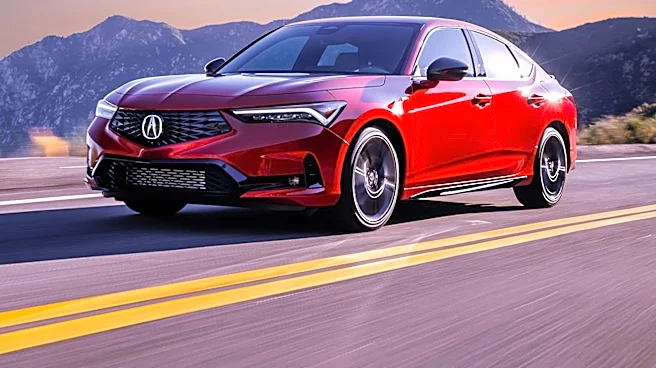
The 2026 Acura Integra Type S is now available for sale in Japan, signifying the first time an Acura-branded vehicle has been exported to the Japanese market. This model is manufactured at Honda's assembly plant in Marysville, Ohio, with engines sourced
from Honda's Anna Engine Plant, also in Ohio. The Integra Type S sold in Japan is identical to its U.S. counterpart, featuring a 320-hp turbocharged 2.0-liter inline-four engine, a six-speed manual transmission, a limited-slip differential, Brembo brakes, and 19-inch wheels with summer tires. Notably, these vehicles are left-hand-drive, which is an anomaly in Japan's predominantly right-hand-drive market. Honda has a history of exporting vehicles from Ohio to Japan, having shipped nearly 300,000 Hondas since 1988, but this marks a new chapter for the Acura brand specifically.
Why It's Important?
This move is significant for the U.S. automotive manufacturing sector, as it highlights the global demand for American-built vehicles and strengthens the export capabilities of U.S.-based production facilities. The export of the Acura Integra Type S, designed and built in the United States, demonstrates the quality and appeal of American automotive engineering on an international stage. For Honda, it represents a strategic expansion of the Acura brand into its home market, potentially opening doors for more Acura models to be introduced in Japan. This could lead to increased production and job opportunities within Honda's Ohio plants, benefiting the local economy and reinforcing the U.S. as a key hub for automotive manufacturing and export. The success of this venture could also influence other foreign automakers with U.S. manufacturing operations to consider similar export strategies.
What's Next?
While the exact number of units to be sold in Japan and their precise pricing have not been released, the vehicles are expected to retail for around $56,000, similar to U.S. pricing. The reception of the Integra Type S in the Japanese market will be closely monitored by Honda. If the enthusiast-centered performance sedan is well-received, it could pave the way for additional Acura models to be exported to Japan in the future. This initial export serves as a test case for Acura's brand presence and market viability in Japan, potentially leading to a broader internationalization strategy for U.S.-produced Acura vehicles. Future developments will likely include announcements regarding sales figures and any subsequent plans for expanding the Acura lineup in Japan.
Beyond the Headlines
The export of a left-hand-drive vehicle to a right-hand-drive market like Japan carries cultural and practical implications. It suggests a strong desire among Japanese consumers for this specific U.S.-built model, potentially driven by its performance characteristics and unique brand appeal. This could also signal a shift in consumer preferences in Japan, where exclusivity and performance might outweigh the practical considerations of driving a left-hand-drive car. From a broader perspective, this initiative underscores the increasing globalization of the automotive industry and the blurring lines between domestic and international markets. It also highlights the strategic importance of U.S. manufacturing plants not just for domestic supply but as global export hubs, contributing to the U.S. trade balance and showcasing American industrial capabilities.