






What's Happening?
Cerebras Systems Inc. experienced a significant drop in its stock price, falling 4.9% on Friday to close at $82.67. This decline followed a broader sell-off in semiconductor stocks on Thursday, which market observers, including The Globe and Mail, attributed
to new U.S. export controls on high-performance chips. These regulations, implemented by the U.S. Department of Commerce, now require special authorization for the export of certain chips to Singapore, Malaysia, Indonesia, Thailand, and Brazil. Despite this recent downturn, Cerebras Systems' stock remains 6.2% above its 52-week low. The company had previously announced strong third-quarter 2026 results on November 12, including a new agreement with Microsoft for computing power. Furthermore, Cerebras raised its core business revenue forecast for fiscal year 2026 to a range of $940 million to $960 million, an increase from its earlier projection of $880 million to $890 million.
Why It's Important?
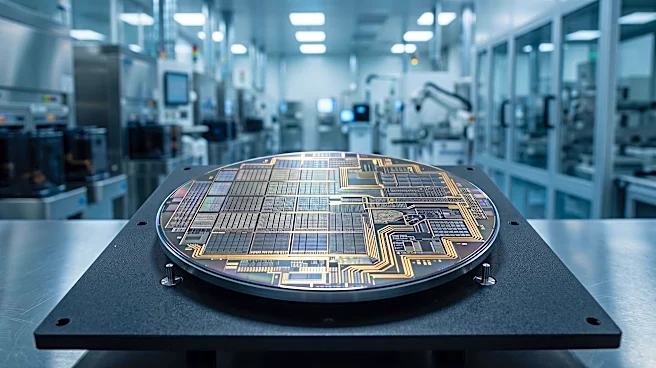
The recent stock decline for Cerebras Systems highlights the significant impact of U.S. trade policy on the semiconductor industry, particularly for companies involved in advanced AI chip development. The new export controls signal a strategic effort by the U.S. government to manage the global distribution of critical technology, potentially to safeguard national security interests or maintain technological leadership. For Cerebras, a company specializing in wafer-scale AI processors, these restrictions could complicate its international sales and supply chain logistics, even as it secures major domestic partnerships like the one with Microsoft. The broader semiconductor sell-off indicates market sensitivity to regulatory changes, suggesting that investors are factoring in increased geopolitical risks and potential market fragmentation. This situation could lead to a re-evaluation of investment strategies within the tech sector, favoring companies with less exposure to restricted markets or those with strong domestic demand.
What's Next?
In the immediate future, Cerebras Systems will likely need to assess the full implications of the new U.S. export controls on its international business operations and sales strategies. The company's ability to navigate these regulations, potentially by seeking necessary export licenses or adjusting its market focus, will be crucial for its stock performance. Investors will be closely watching for any official statements or revised guidance from Cerebras regarding the impact of these controls. The broader semiconductor industry may also see further adjustments as companies adapt to the new regulatory landscape, potentially leading to shifts in manufacturing locations or supply chain partnerships. The agreement with Microsoft, however, provides a strong domestic revenue stream that could help mitigate some of the international challenges, with Microsoft-related revenues expected to commence in early 2027. The market will also monitor how other nations react to these U.S. export policies, which could influence global trade dynamics in high-tech sectors.
Beyond the Headlines
The U.S. government's implementation of stricter export controls on high-performance chips reflects a growing trend of technological nationalism and strategic competition, particularly in the advanced computing and artificial intelligence sectors. This move goes beyond immediate economic impacts, touching upon long-term geopolitical strategies where control over cutting-edge technology is seen as a critical component of national power. For companies like Cerebras, this environment necessitates a delicate balance between global market expansion and compliance with evolving national security directives. It could also accelerate the development of domestic AI infrastructure and chip manufacturing capabilities within the U.S., as companies seek to reduce reliance on potentially restricted international supply chains. Furthermore, these controls might inadvertently spur other nations to invest more heavily in their own indigenous chip development, leading to a more fragmented global technology landscape and potentially altering the pace and direction of AI innovation worldwide.