
What's Happening?
Infineon Technologies AG, a global semiconductor leader, and SOLUM Co., Ltd. have signed a Memorandum of Understanding (MoU) to enhance their existing collaboration on high-voltage direct current (HVDC)
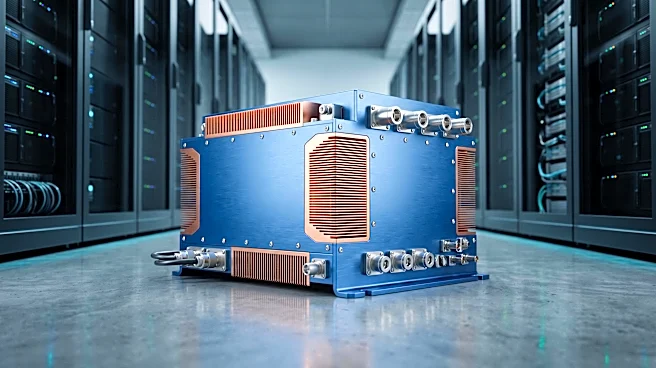
power solutions specifically designed for AI data centers. This expanded partnership will focus on three key power applications: intermediate bus converters (IBCs), battery backup units (BBUs), and power supply units (PSUs). The collaboration aims to address the increasing power demands of generative AI and high-performance computing, which necessitate greater energy efficiency, power density, and system reliability in data center infrastructure. Infineon will provide its semiconductor and system expertise, including silicon (Si), silicon carbide (SiC), and gallium nitride (GaN) power semiconductors, along with reference designs and technical support. SOLUM will contribute its server power design and manufacturing capabilities to develop AI data center power products and pursue global customer opportunities. A 26 kW-class BBU DC/DC converter for 800 Vdc rack power architectures, designed to support AI server operations during power interruptions, was showcased, targeting mass production by 2027 with over 98.5% peak efficiency.
Why It's Important?
This collaboration is crucial for the U.S. technology sector, particularly for companies operating or building AI data centers. As AI technologies, especially generative AI, become more prevalent, the demand for robust, efficient, and reliable power infrastructure is skyrocketing. HVDC-based power architectures offer significant advantages by reducing power losses and improving reliability through more efficient power conversion and distribution. The partnership between Infineon, a global leader with a U.S. presence, and SOLUM will accelerate the development and deployment of these advanced power solutions. This directly impacts the operational costs and environmental footprint of AI data centers, which are significant energy consumers. U.S. businesses relying on AI for various applications stand to benefit from more stable and efficient computing environments, potentially leading to faster innovation and reduced operational expenses. The focus on high-efficiency solutions also aligns with broader sustainability goals, making AI data centers more environmentally friendly.
What's Next?
The immediate next steps involve Infineon and SOLUM maintaining a regular technical dialogue on next-generation developments and Infineon providing early-stage support, reference designs, and technical assistance for SOLUM's projects. SOLUM will continue to apply its manufacturing capabilities to develop AI data center power products, with a specific focus on North American markets. The showcased 26 kW-class BBU DC/DC converter, designed for 800 Vdc rack power architectures, is targeted for mass production by 2027. This indicates a clear timeline for the commercialization of some of the collaborative efforts. The ongoing technical cooperation is expected to lead to the introduction of more high-efficiency HVDC solutions, which will be critical for the continuous growth and sustainability of AI data centers globally, including those in the U.S. The partnership aims to strengthen SOLUM's high-voltage, high-efficiency power design capabilities and open new business opportunities in the AI data center power markets.
Beyond the Headlines
The deeper implications of this collaboration extend to the foundational infrastructure supporting the AI revolution. The increasing power demands of AI are not just a technical challenge but also an economic and environmental one. By focusing on HVDC power solutions, Infineon and SOLUM are addressing the need for more sustainable and cost-effective ways to power these energy-intensive operations. This shift towards more efficient power architectures could set new industry standards for data center design and operation, influencing procurement decisions and technological roadmaps across the U.S. and globally. Furthermore, the emphasis on reliability and continuity of AI server operations during power interruptions highlights a critical vulnerability in current data center designs, which this partnership aims to mitigate. This could lead to enhanced resilience of AI-driven services, which are becoming increasingly integral to various sectors, from finance to healthcare.