

What's Happening?
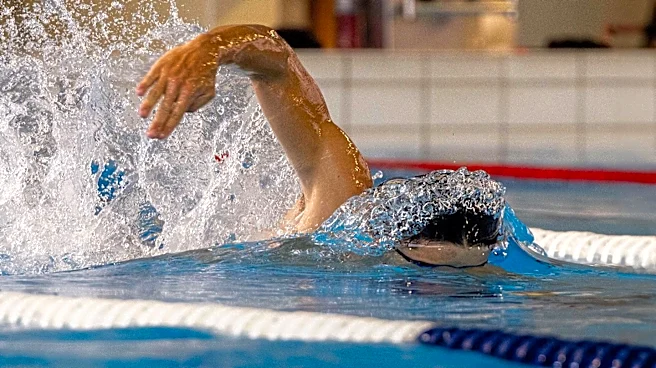
At the Texas Hall of Fame Swimming Invite in Austin on November 19, 2026, three Texas women swimmers, Jillian Cox, Lillie Nesty, and Audrey Derivaux, completed the 500-yard freestyle event with times clustered around 4:32.00. Jillian Cox won with 4:32.00,
followed closely by Lillie Nesty at 4:32.12, and Audrey Derivaux at 4:32.21. These performances are approximately eight seconds off Katie Ledecky's NCAA record of 4:24.06 set in 2017. The times are, however, well within the 2026 NCAA 'A' final mark of 4:37.43, indicating a highly competitive season for women's collegiate swimming. Other notable performances at the event included Nikolett Padar (Texas), Zoe Nordmann (Northwestern), Inez Miller (Texas), Izzy Enz (Wisconsin), and Erin Gemmell (Texas) also placing in the top eight.
Why It's Important?
The close finishes among the top Texas swimmers in the 500-yard freestyle highlight the escalating competitiveness in collegiate women's swimming. These early-season results suggest that swimmers will need to achieve significantly faster times to secure a spot in the top eight at the upcoming NCAA Championships. The benchmark set by Katie Ledecky's 2017 record continues to define excellence in the event, pushing current athletes to strive for new personal bests. The performance of these Texas swimmers, along with Kennedi Dobson's SEC record of 4:30.48, indicates a strong field emerging for the 2026-2027 season. This intense competition is crucial for the sport's development, fostering higher performance standards and potentially leading to new records.
What's Next?
The focus for these swimmers and their teams will be on maintaining and improving their times in subsequent meets throughout the season. The 4:44.93 qualifying mark for the 2027 NCAA Championships serves as a concrete target for athletes aiming for national competition. Coaches and recruiters will closely monitor whether these top Texas swimmers can consistently achieve or surpass their current 4:32 times, and more importantly, how much they can shave off these times to meet the increasingly demanding NCAA 'A' final standards. The trajectory of these performances will be a key indicator of which athletes are on track for success at the NCAA Championships, influencing team strategies and individual training regimens.
Beyond the Headlines
The consistent improvement and tight competition seen in events like the 500-yard freestyle reflect broader trends in collegiate sports, where athletic programs are continually pushing the boundaries of performance. The pursuit of excellence, driven by both individual ambition and team dynamics, contributes to the overall prestige and excitement of NCAA swimming. The legacy of athletes like Katie Ledecky serves as an inspiration, motivating a new generation of swimmers to dedicate themselves to rigorous training and strategic competition. This environment not only produces elite athletes but also fosters a culture of discipline, resilience, and continuous improvement within collegiate sports.