







What's Happening?
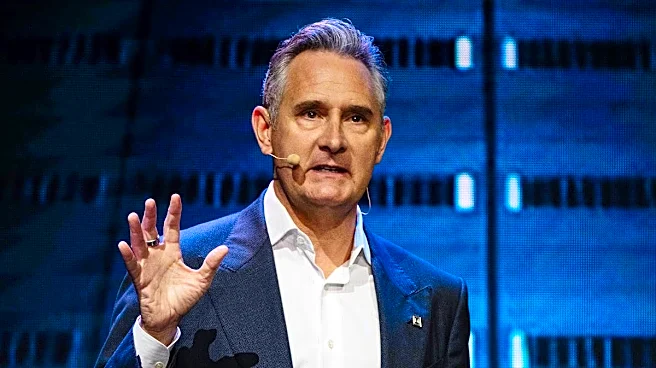
Amazon CEO Andy Jassy has acknowledged that the company is facing challenges in meeting the high demand for Graphics Processing Units (GPUs) despite increasing its planned capital spending. Jassy stated in July that Amazon would be unable to satisfy all anticipated
demand, a situation he expects to persist into 2027. This comes as Amazon Web Services (AWS) reported a 37% increase in revenue to $42.2 billion in Q2, marking its fastest growth in over four years, with a contract backlog reaching $496 billion. The company is reportedly exploring options to finance its substantial AI infrastructure buildout, including a proposal to move approximately $8 billion worth of Nvidia Grace Blackwell chips into a special-purpose vehicle financed by external investors, then leasing the hardware back. This strategy aims to make Amazon's AI expansion more asset-light, as its capital spending is projected to hit $220 billion this year. Jassy has previously described generative AI as a 'once-in-a-lifetime' technology, indicating its strategic importance to Amazon's future.
Why It's Important?
Amazon's aggressive investment in AI infrastructure and its struggle to meet GPU demand highlight the intense competition and rapid expansion within the artificial intelligence sector. The proposed financing structure for Nvidia chips suggests a strategic shift to manage the immense capital expenditure required for AI development, potentially influencing how other tech giants fund their own AI initiatives. The robust growth of AWS, Amazon's cloud computing division, provides a strong financial foundation for these investments, but the inability to fully satisfy demand indicates a broader industry-wide shortage of critical AI hardware. This situation could impact the pace of AI innovation and deployment across various sectors, as companies reliant on cloud providers for AI capabilities may face delays or increased costs. The emphasis on AI as a 'once-in-a-lifetime' technology by CEO Andy Jassy underscores its perceived transformative potential for Amazon's business model and customer experiences, making the efficient scaling of its AI infrastructure a critical factor for its long-term competitiveness.
What's Next?
Amazon's strategy for financing its AI infrastructure, particularly the potential use of special-purpose vehicles for GPU acquisition, will be closely watched by investors and competitors. The success of this model could set a precedent for how large-scale AI investments are managed in the future, potentially allowing companies to maintain balance-sheet flexibility while still accessing cutting-edge technology. The ongoing GPU shortage is expected to continue into 2027, suggesting that Amazon and other cloud providers will need to explore diverse methods of acquiring computing power, including partnerships with neoclouds and allowing customers to bring their own hardware. The company's ability to secure sufficient AI resources will directly impact its capacity to innovate and deliver new AI-powered services, which are crucial for maintaining its competitive edge in cloud computing and e-commerce. Further announcements regarding financing deals, supply chain optimizations, and new AI service offerings are anticipated as Amazon navigates this high-growth, high-investment phase.
Beyond the Headlines
The challenges Amazon faces in securing GPUs and financing its AI ambitions reflect a broader technological and economic shift. The insatiable demand for AI computing power is not only driving unprecedented capital expenditure but also reshaping supply chains and financial models within the tech industry. The move towards asset-light financing for critical hardware like GPUs could signal a new era of infrastructure investment, where specialized financial instruments become commonplace for funding advanced technological capabilities. This trend could lead to increased financialization of tech assets and potentially alter the risk profiles of major tech companies. Furthermore, the strategic importance placed on generative AI by Amazon's leadership suggests a fundamental re-evaluation of business processes and customer interactions across the company's vast ecosystem. The long-term implications could include a more AI-driven economy, where access to and efficient utilization of AI infrastructure become paramount determinants of corporate success and market leadership.