




What's Happening?
A new report by British market research company IDTechEx indicates that China has become the primary driver of the global green hydrogen market. The People's Republic currently holds approximately 19 gigawatts of firmly committed production capacity for
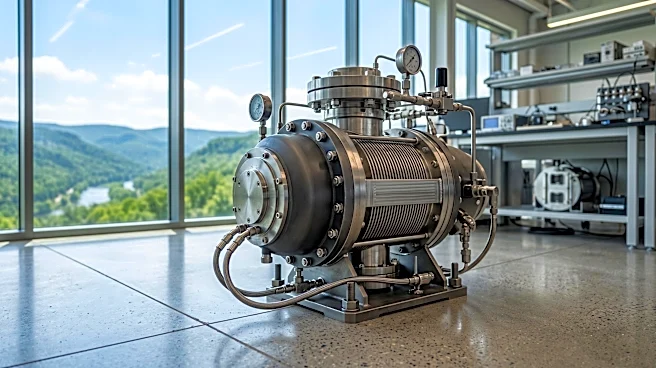
green hydrogen, representing about 55% of the global project pipeline that has reached a final investment decision (FID). China is also the world's largest producer and consumer of hydrogen, accounting for over a quarter of global production. More than 60% of China's hydrogen investments with FID are directed towards green hydrogen, with only about 1% allocated to blue hydrogen. This strategy contrasts with Europe and North America, where blue hydrogen plays a more significant transitional role. The report also highlights China's dominance in the electrolyzer market, with Chinese suppliers holding at least 60% of global manufacturing capacity in 2026, offering components and systems that are significantly cheaper than international alternatives.
Why It's Important?
China's aggressive push into green hydrogen signifies a major shift in global energy dynamics and its commitment to decarbonization. Its substantial lead in project pipeline and electrolyzer manufacturing capacity positions it as a critical player in the global energy transition. This dominance could influence international supply chains, technology standards, and the overall cost of green hydrogen worldwide. For other nations, including the U.S., China's rapid advancement presents both opportunities for collaboration and challenges in terms of competitiveness. The lower cost of Chinese electrolyzers, driven by large-scale production and integrated supply chains, could accelerate the adoption of green hydrogen globally but also raises concerns about market concentration and potential trade imbalances. The strategic anchoring of hydrogen in China's 15th Five-Year Plan underscores its long-term commitment to the sector as a future growth driver.
What's Next?
IDTechEx anticipates that China will remain the main driver of the global green hydrogen market over the next decade. However, the report suggests that China may not achieve the same level of dominance in the electrolyzer market as it has in solar modules. This is due to the complexity of electrolyzers as integrated systems requiring significant engineering expertise and local EPC services. Furthermore, an increasingly fragmented market environment, influenced by regulations like the U.S. rules on 'Foreign Entities of Concern' (FEOC) and restrictions in European funding programs, is expected to foster the development of regional supply chains. This could create opportunities for non-Chinese suppliers who can offer higher initial investments offset by longer operating life, better reliability, and higher system efficiency, leading to lower levelized costs of hydrogen (LCOH) over project lifetimes.
Beyond the Headlines
China's strategic focus on green hydrogen extends beyond energy production; it is integrated into broader industrial policy aimed at fostering 'Future Industries' and achieving national decarbonization goals. The country's approach, emphasizing green hydrogen over blue hydrogen, signals a long-term vision for a fully renewable energy system. This could accelerate global innovation in green hydrogen technologies and drive down costs, making it more accessible worldwide. However, the reliance on Chinese manufacturing for critical components could also create geopolitical dependencies and supply chain vulnerabilities for other nations. The development of regional supply chains, spurred by trade policies, indicates a potential future where the green hydrogen market is diversified rather than dominated by a single country, balancing global collaboration with national energy security interests.