






What's Happening?
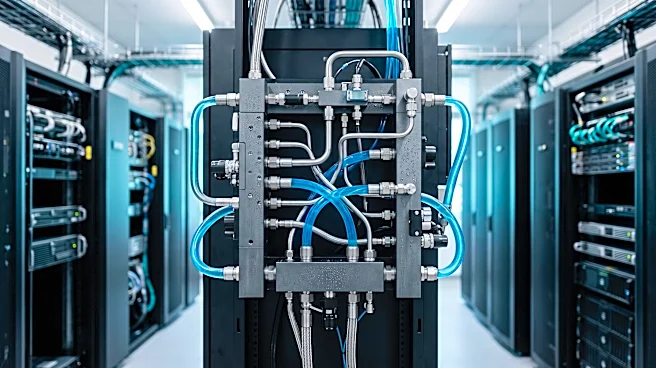
Nvidia has introduced new developments in liquid cooling for its Blackwell data center hardware, claiming a 300x boost in water efficiency. The hardware utilizes liquid cooling to lower temperatures, and its closed-loop systems are designed to significantly
reduce water usage by constantly recycling the water within the system. This means that once the water is introduced, it rarely needs refilling. Nvidia also reported in June 2026 that it is successfully cooling its hardware with 45-degree Celsius liquid. While these innovations improve water efficiency within the data center racks, the broader issue of massive water consumption for power generation to supply these data centers remains unresolved. Many U.S. data centers still rely heavily on fossil fuel plants, contributing to significant water usage and environmental concerns.
Why It's Important?
Nvidia's advancements in liquid cooling are crucial for the sustainability of the rapidly expanding AI data center industry in the U.S. By drastically improving water efficiency within the data center itself, Nvidia helps mitigate one aspect of the environmental impact of these energy-intensive facilities. This is particularly important as data centers are projected to see a 130% increase in energy usage in the U.S. by 2030. However, the reliance on water-intensive power generation methods, especially fossil fuels, means that the overall water footprint of data centers remains substantial. This highlights a critical challenge for the U.S. infrastructure, as the grid struggles to keep up with the power demands of AI, leading to concerns about water supply in regions with large data center concentrations, such as Georgia and Tennessee.
What's Next?
While Nvidia's liquid cooling solutions offer internal water efficiency, the industry faces the larger hurdle of sustainable power generation. Future efforts will likely focus on integrating data centers with renewable energy sources and developing more water-efficient power plants. There will be continued pressure on manufacturers and data center operators to address the external water consumption associated with electricity production. Regulatory bodies and local communities may also increase scrutiny on data center water usage, potentially leading to new policies or incentives for more sustainable practices. The ongoing build-out of data centers will necessitate a comprehensive approach to both internal cooling efficiency and external power generation sustainability.
Beyond the Headlines
The challenge of cooling AI data centers extends beyond mere technological solutions; it touches upon critical environmental, economic, and social issues. The massive water consumption for power generation, particularly in regions already facing water scarcity, raises ethical questions about resource allocation and environmental justice. Economically, the strain on existing power grids and water supplies could lead to increased operational costs for data centers and potential conflicts with local communities. The long-term implications include the need for significant investment in renewable energy infrastructure and advanced water management systems to support the growth of AI without exacerbating environmental crises. This situation underscores the complex interplay between technological advancement and sustainable development.