






What's Happening?
Marathon Petroleum, one of the largest independent petroleum refiners in the United States, experienced a substantial financial surge in the second quarter of 2026. The company reported a net income of approximately $5.1 billion and adjusted earnings
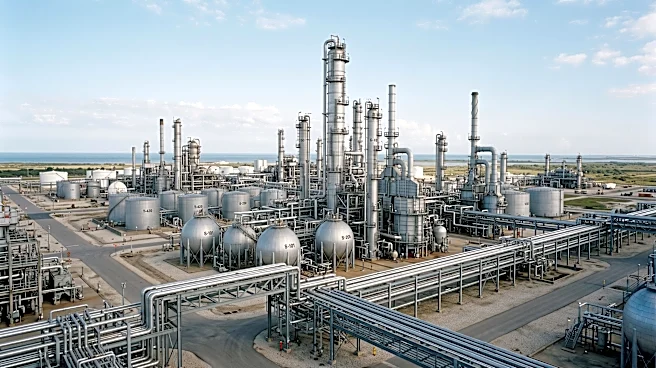
per share of $17.73. This performance was largely driven by record-high refining margins, which climbed to $36.33 per barrel, a significant increase from $17.58 a year earlier. The company's refinery utilization reached 94%, indicating high operational efficiency. These record margins are attributed to a global shortage of refined products, stemming from supply disruptions due to conflicts in the Middle East and Ukraine, reduced fuel exports from Asia, and tight diesel inventories. Marathon Petroleum also returned over $2.8 billion to shareholders during this period. The company operates refineries across the Gulf Coast, Midwest, and West Coast, converting crude oil into various products including gasoline, diesel, jet fuel, and asphalt, and has expanded into renewable diesel. Its integrated logistics network, including a majority interest in MPLX, provides a stable cash-flow stream.
Why It's Important?
The exceptional financial performance of Marathon Petroleum highlights the current volatility and profitability within the U.S. energy sector, particularly in refining. Record refining margins indicate a tight global supply of refined products, which directly impacts fuel prices for consumers and operational costs for businesses across the United States. This situation benefits refiners like Marathon Petroleum, allowing them to generate significant earnings and return capital to shareholders through buybacks and dividends. However, it also signals potential economic pressures for other sectors reliant on affordable fuel, such as transportation and manufacturing. The geopolitical factors contributing to these disruptions underscore the interconnectedness of global events and their immediate effects on U.S. industries. The company's expansion into renewable diesel also points to a strategic shift within the industry towards more sustainable energy sources, balancing traditional refining with future energy demands. The sustained high margins could lead to increased investment in refining capacity or alternative fuels, potentially reshaping the energy landscape.
What's Next?
The durability of the current high refining margins remains a central question for Marathon Petroleum and its investors. The company's third-quarter earnings, expected in early November, will provide further insight into how these record margins translated into profitability. Management commentary on fourth-quarter capture rates and maintenance schedules will be closely scrutinized for indications of future performance. Key variables that could influence these margins include the pace of recovery in Russian and Middle Eastern refining capacity, changes in Chinese and Asian product exports, and global demand for diesel and jet fuel. Longer-term, investors will monitor Marathon Petroleum's capital returns, the growth trajectory of its midstream partnership MPLX, and its investments in renewable diesel. The company faces risks such as a sharp normalization of crack spreads, a slowdown in economic activity impacting fuel demand, and potential regulatory or environmental shifts. Analysts' views are divided, with some raising price targets due to strong margins, while others caution that margins may normalize.
Beyond the Headlines
The current environment of record refining margins for Marathon Petroleum extends beyond immediate financial gains, touching upon broader ethical and economic considerations. The reliance on global geopolitical stability for stable energy supplies highlights the vulnerability of the U.S. economy to international conflicts and trade policies. While refiners profit from these disruptions, consumers face higher fuel costs, which can disproportionately affect lower-income households and small businesses. This situation also brings into focus the debate around energy independence versus global energy interdependence. Furthermore, Marathon Petroleum's investment in renewable diesel, while a step towards sustainability, also raises questions about the pace and scale of the transition away from fossil fuels. The ethical implications of profiting from global crises, even indirectly, are also part of the broader societal discussion. The long-term shift towards renewable energy sources could eventually mitigate such vulnerabilities, but the immediate challenge lies in balancing energy security, economic stability, and environmental responsibility.