






What's Happening?
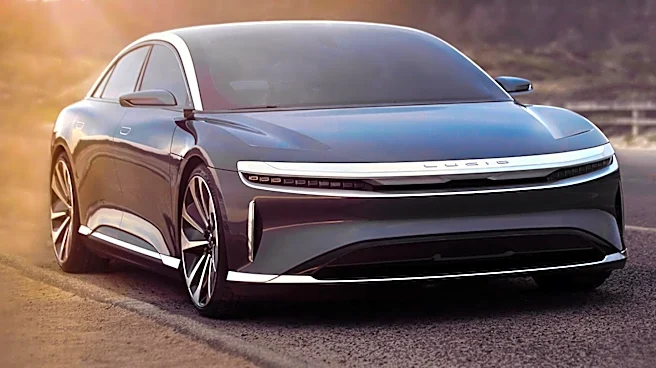
Lucid Group, an electric vehicle manufacturer specializing in high-performance luxury cars, is confronting significant operational hurdles and ongoing financial losses. Despite a 68% increase in revenue to approximately $1.35 billion in fiscal year 2025,
the company reported a net loss of about $3.7 billion for the same period. This indicates that the costs associated with building manufacturing facilities and developing new technology continue to outweigh current sales. The company's new CEO, Silvio Napoli, has acknowledged the need for operational changes, particularly addressing issues with fulfilling orders and assisting potential customers. Lucid plans to increase its technical and support staff by 35% and mobile service capacity by over 20%, aiming to reduce customer wait times by more than 30%. The company also faces a debt-to-equity ratio of nearly 1.2x and a negative free cash flow of roughly $3.8 billion for the fiscal year.
Why It's Important?
Lucid's struggles highlight the significant capital investment and operational complexities involved in scaling an electric vehicle startup, even in the luxury segment. The company's reliance on a critical commercial agreement with the government of Saudi Arabia, which committed to purchasing up to 100,000 vehicles over ten years, introduces a layer of customer concentration risk. The operational inefficiencies, such as failing to fulfill orders, directly impact customer satisfaction and market perception, which are crucial for a premium brand. The substantial net losses and negative free cash flow raise concerns about the company's long-term financial sustainability and its ability to compete effectively against established luxury automakers and other EV players. The planned improvements in service and support are vital for retaining existing customers and attracting new ones in a competitive market.
What's Next?
Lucid's immediate future involves implementing the strategic changes outlined by CEO Silvio Napoli, focusing on improving customer service, parts availability, and service operations to reduce wait times. The company anticipates slower sales in the near term, with Wall Street projecting revenue to increase to about $1.5 billion this year and the net loss to narrow to $800 million. Longer-term, Lucid is exploring opportunities in the robotaxi market. The company is also defending itself against shareholder lawsuits alleging misleading investors about supplier quality and delivery schedules for its Gravity SUV. Successfully navigating these legal challenges and demonstrating consistent operational improvements will be critical for Lucid to regain investor confidence and achieve profitability. The transition to a new CEO also means a period of strategic adjustment and execution.
Beyond the Headlines
The challenges faced by Lucid Group underscore the broader difficulties for new entrants in the automotive industry, particularly in the capital-intensive electric vehicle sector. While Lucid's focus on ultra-luxury and advanced technology positions it uniquely, the path to profitability is arduous, marked by high development costs, manufacturing complexities, and the need for robust customer support infrastructure. The company's situation also reflects the evolving landscape of investor expectations for EV startups, moving beyond initial hype to demand tangible operational efficiency and financial viability. The outcome of Lucid's efforts to streamline operations and achieve profitability could serve as a case study for other emerging EV manufacturers, illustrating the critical balance between innovation, production scale, and financial discipline.