




What's Happening?
Psychological scientists are actively researching and envisioning the future of work, specifically focusing on the integration of artificial intelligence (AI) as colleagues. This exploration considers both the potential benefits and harms for human workers.
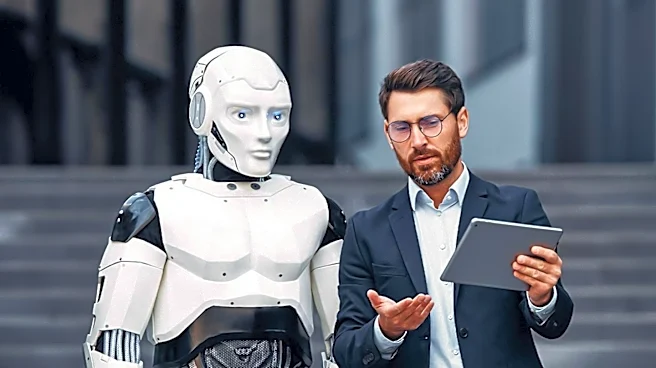
Researchers Andrea Bazzoli and Mindy Shoss, in their upcoming paper in *Perspectives on Psychological Science*, delve into various scenarios, including the impact of data tracking, the blurring lines between human and robot colleagues, AI's role in a climate-affected world, and potential worker exploitation. They highlight that while intensified data collection could offer tailored feedback, it also poses risks to worker privacy and independence. Separately, Cleotilde Gonzalez and Tailia Malloy, in *Current Directions in Psychological Science*, advocate for designing AI to complement human cognition, distinguishing between 'cognitive AI' that models human tendencies and 'machine AI' focused on data optimization. They emphasize the need for AI systems that can replicate human errors to better predict and prevent them.
Why It's Important?
The integration of AI into the U.S. workforce carries significant implications for industries, public policy, and societal structures. The research by Bazzoli and Shoss underscores the need for careful consideration of how AI technologies are controlled and whose interests they serve, as this will shape future working lives. The potential for increased data tracking raises concerns about worker privacy and autonomy, which could necessitate new regulations and ethical guidelines in the workplace. Conversely, AI could perform dangerous jobs in environments impacted by climate change, improving worker safety but also requiring policies to support displaced workers. Gonzalez and Malloy's work on 'cognitive AI' is crucial for developing AI that genuinely enhances human capabilities rather than merely competing with them, potentially leading to more effective and harmonious human-AI teams across various sectors.
What's Next?
The ongoing research by psychological scientists aims to inform the development and implementation of AI in the workplace. Future steps involve psychologists collaborating with technologists, policymakers, and workers to shape equitable and sustainable AI integration. This includes establishing rules for AI use and ensuring that research methods intended to support workers do not inadvertently enable surveillance or exploitation. The focus will be on creating AI systems that understand and adapt to human limitations and biases, fostering meaningful collaboration. As AI becomes more ubiquitous, there will be a continued need to address questions of data ownership, fair compensation, and how to maintain human purpose and belonging in a world where traditional employment roles may shift significantly.
Beyond the Headlines
The deeper implications of AI integration extend to fundamental shifts in the nature of work and human interaction. The concept of 'cognitive AI' that can replicate human errors suggests a more nuanced approach to AI development, moving beyond pure efficiency to a more human-centric design. This could lead to AI systems that are not just tools but genuine collaborators, capable of understanding and adapting to human thought processes. However, the ethical challenge lies in ensuring that such predictive powers are used for empowerment rather than manipulation. The potential for AI to perform dangerous jobs also raises questions about the value of human labor and the need for societal frameworks that support individuals whose livelihoods are impacted. Ultimately, the development of AI will necessitate a re-evaluation of human dignity, respect, and the meaning of work in an increasingly automated world.