




What's Happening?
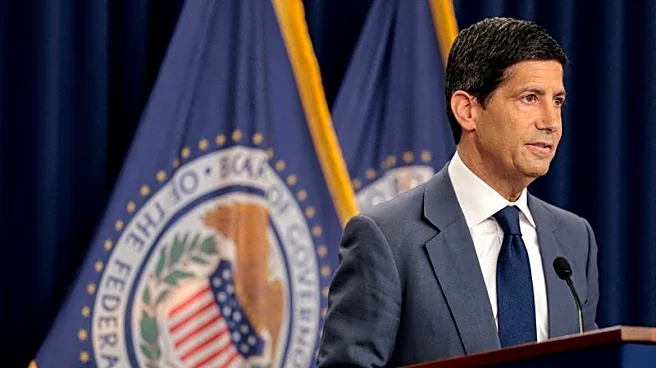
Federal Reserve Chairman Kevin Warsh is advocating for the central bank to enhance its understanding of how artificial intelligence will reshape the U.S. economy. As AI rapidly develops, it presents new questions regarding inflation, employment, and economic
growth. Warsh revealed that the Fed is modeling various scenarios to assess AI's potential economic impact, ranging from spurring rapid growth and innovation to causing widespread job losses. Despite AI's early stages, it already contributes significantly to economic growth, investment, and stock market gains. The Fed's semiannual financial stability report highlighted AI-related risks as the top concern for the financial system, with 87% of respondents citing issues like cyberattacks, disappointing earnings, and complex AI financing. Warsh emphasized the Fed's role is neither advocacy nor opposition but to prepare for future economic shifts, acknowledging the unique challenges AI poses with few historical parallels.
Why It's Important?
The Federal Reserve's struggle to predict AI's economic impact underscores the unprecedented nature of this technological shift. AI has the potential to fundamentally alter economic structures, making traditional forecasting models less reliable. The uncertainty surrounding AI's effects on productivity, inflation, and employment directly impacts monetary policy decisions. If AI leads to significant productivity gains, it could help mitigate inflation, but if it causes widespread job displacement, it could lead to higher unemployment and social instability. The risk of an 'AI bubble' and a subsequent market correction also poses a threat to financial stability. The Fed's proactive approach to understanding AI is crucial for developing appropriate policy responses to maintain economic stability and ensure the U.S. remains a leader in AI development, which Warsh suggests is vital for sustaining superpower status.
What's Next?
The Federal Reserve will continue its efforts to model various economic scenarios related to AI, aiming to ask the right questions and prepare for potential outcomes. This involves ongoing research and analysis by the task force created by Chairman Warsh. Future monetary policy decisions will likely be influenced by emerging data on AI's impact on productivity, labor markets, and inflation, though Fed officials remain cautious about making definitive predictions. The central bank will also monitor investment trends in the AI sector for signs of a bubble or market correction. As AI technology advances, the Fed may need to adapt its tools and frameworks to address new economic realities, potentially collaborating with other government agencies and international bodies to develop a comprehensive understanding and response to AI's transformative effects.
Beyond the Headlines
The Fed's grappling with AI's economic implications highlights a broader societal challenge: how institutions designed for a pre-AI era adapt to a rapidly changing technological landscape. The lack of historical parallels for AI's potential disruption means policymakers are navigating uncharted territory, requiring innovative thinking and flexibility. Beyond immediate economic indicators, AI raises profound questions about the future of work, wealth distribution, and the very nature of economic value. The debate over whether AI will complement or displace human labor has significant social and ethical dimensions, potentially exacerbating inequality if not managed effectively. The Fed's cautious approach reflects the immense uncertainty and the need for a nuanced understanding that goes beyond traditional economic metrics, touching upon technological, social, and even philosophical considerations about humanity's role in an AI-driven economy.