











What's Happening?
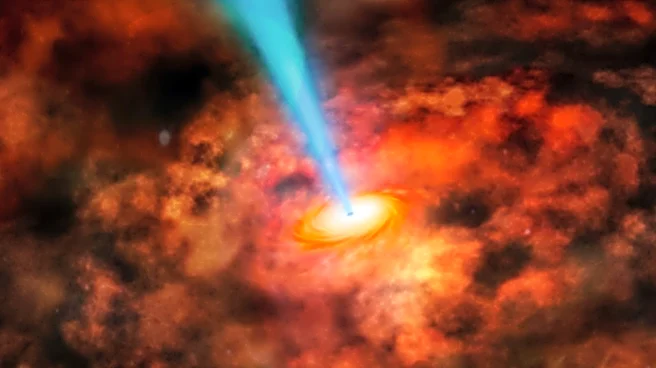
Researchers at the Advanced Science Research Center have successfully simulated black hole phenomena in a laboratory setting. By creating a synthetic rotation framework, they have replicated conditions similar to those found in the ergosphere of a black hole,
where space is dragged by rotation. This experiment, published in Nature, uses a novel radio-frequency device to mimic ultrafast rotation, allowing for the study of wave amplification phenomena predicted by physicists like Sir Roger Penrose and Yakov Zel’dovich. The device employs a ring-shaped network of electronic resonators to create a traveling wave pattern, enabling waves to extract energy from synthetic rotation.
Why It's Important?
This breakthrough has profound implications for both fundamental physics and practical applications. By bridging the gap between theoretical astrophysical concepts and experimental reality, the research opens new avenues for exploring wave dynamics under extreme conditions. The ability to simulate black hole-like phenomena in a controlled environment could lead to advancements in communications, optics, and photonics. The findings also suggest potential for future technologies in quantum information processing and light manipulation, offering a versatile toolkit for scientific and technological innovation.