





What's Happening?
PepsiCo, a major consumer staples company, is experiencing strong international growth, with its LatAm Foods growing 14% and Asia Pacific Foods growing 10% in the third quarter. Chief executive Ramon Laguarta noted that international markets contributed
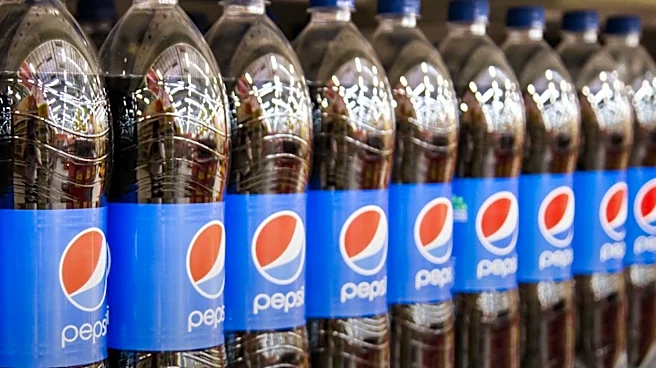
45% of the company's profit year-to-date, describing this momentum as 'much more structural.' The company's third-quarter revenue reached $25.27 billion, surpassing estimates, and core EPS also exceeded expectations. However, PepsiCo is facing significant headwinds in its North American operations. Core operating profit at PepsiCo Foods North America declined by 12% in the third quarter, and Laguarta explicitly stated that the company is 'not competing well in soft drinks.' This has led PepsiCo to cut its core EPS growth guidance for the year to +2.5% to +3.5%. Input costs are also trending higher as hedges expire, according to the chief financial officer. Despite these domestic issues, the company has extended its partnership with Taco Bell for another 11 years and has seen a turnaround in North American snack volumes, moving from a low-single-digit decline to low-single-digit growth.
Why It's Important?
The performance of PepsiCo, a bellwether in the consumer staples sector, has significant implications for investors and the broader U.S. economy. The company's struggles in its North American beverage business and the decline in operating profit for its North American food division highlight challenges within the mature U.S. market, potentially signaling shifts in consumer preferences or increased competitive pressures. This situation could impact investor confidence in other large U.S.-centric food and beverage companies. The company's decision to cut its EPS growth guidance reflects a more cautious outlook for its domestic performance, which could influence broader market sentiment regarding consumer spending and corporate profitability in the U.S. Conversely, the robust international growth demonstrates the importance of diversified global markets for large U.S.-based corporations, providing a buffer against domestic slowdowns. For consumers, potential changes in PepsiCo's competitive strategy in the U.S. soft drink market could lead to new product offerings or pricing adjustments.
What's Next?
Investors and analysts will be closely watching PepsiCo's upcoming February earnings report for more detailed insights into the company's plans for the next year. This report is expected to provide crucial information regarding margins and trends in the U.S. beverage market, which are key areas of concern. Management's strategy to address the underperformance in soft drinks and the decline in North American food operating profit will be critical. The company's ability to manage rising input costs as hedges expire will also be a significant factor influencing future profitability. Depending on the success of these strategies, PepsiCo's stock could see varying returns; projections suggest a $5,000 investment could be worth between $5,389.37 and $6,923.24 by 2030, excluding dividends. The company's ongoing $10 billion share buyback authorization, which runs through February 28, 2030, and its 54th consecutive annual dividend increase, will continue to support shareholder returns.
Beyond the Headlines
PepsiCo's current situation underscores a broader trend in the consumer goods industry: the increasing divergence between mature domestic markets and rapidly growing international markets. While the U.S. market presents challenges such as evolving consumer tastes, heightened competition, and cost pressures, emerging markets offer significant growth opportunities. This dynamic forces multinational corporations to adopt dual strategies, focusing on innovation and efficiency in established regions while aggressively expanding in developing ones. The company's struggle in the U.S. soft drink sector could also reflect a larger societal shift towards healthier beverage options, posing a long-term challenge for traditional soda manufacturers. Furthermore, the emphasis on 'portion-control' snacks, which has become a multi-billion dollar business for PepsiCo, indicates a strategic adaptation to consumer demand for healthier or more controlled consumption habits, highlighting the need for continuous product evolution in the food industry.