






What's Happening?
Global investment bank TD Cowen has maintained its assessment that the Clarity Act, a crypto market structure bill currently before the U.S. Congress, is improbable to pass during the ongoing lame-duck session. According to The Block, TD Cowen sees no
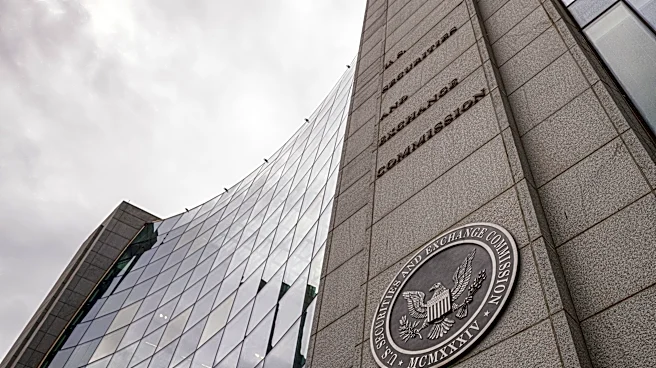
viable path for the bill to clear, primarily because its proponents have not secured the necessary 60 votes to overcome a filibuster in the U.S. Senate. The firm also does not anticipate any other related legislation moving forward alongside it. TD Cowen highlighted the nominations of Kristin Johnson, a Democratic nominee for the U.S. Securities and Exchange Commission, and Matthew Rowland, a Democratic nominee for the Commodity Futures Trading Commission, suggesting their appointments could offer insights into the Democratic Party's future stance on crypto policy.
Why It's Important?
The inability of the Clarity Act to pass during the lame-duck session signifies a continued lack of clear regulatory framework for the cryptocurrency market in the U.S. This legislative stagnation can create uncertainty for businesses operating in the crypto space, potentially hindering innovation and investment. Without defined rules, companies may face regulatory ambiguity, impacting their operational strategies and market entry decisions. The outcome also underscores the challenges of achieving bipartisan consensus on emerging technologies within Congress. Furthermore, the focus on the nominations of Kristin Johnson and Matthew Rowland indicates that future crypto policy direction might heavily depend on the regulatory agencies rather than immediate legislative action, shifting the battleground for crypto regulation from Capitol Hill to executive branch appointments.
What's Next?
With the Clarity Act unlikely to pass, the immediate future of crypto market regulation in the U.S. remains uncertain. The focus will likely shift to the regulatory bodies, particularly the U.S. Securities and Exchange Commission (SEC) and the Commodity Futures Trading Commission (CFTC). The confirmations of Kristin Johnson and Matthew Rowland, if they occur, could provide initial indications of the Democratic Party's approach to crypto policy. Their perspectives and priorities within these key agencies will be crucial in shaping how existing laws are applied to digital assets and whether new regulatory guidance emerges. Industry stakeholders will be closely monitoring these appointments and any subsequent actions by the SEC and CFTC for clarity on compliance and operational standards.
Beyond the Headlines
The ongoing legislative gridlock surrounding crypto regulation highlights a broader challenge in governing rapidly evolving technological sectors. The lack of a comprehensive framework could lead to a fragmented regulatory landscape, where different states or agencies adopt varying approaches, potentially creating inefficiencies and compliance burdens for businesses operating nationwide. This situation also raises questions about the U.S.'s competitiveness in the global digital asset space, as other countries move forward with clearer regulatory structures. The debate over the Clarity Act also touches upon the fundamental tension between fostering innovation and ensuring consumer protection and financial stability, a balance that policymakers continue to grapple with in the digital age.