




What's Happening?
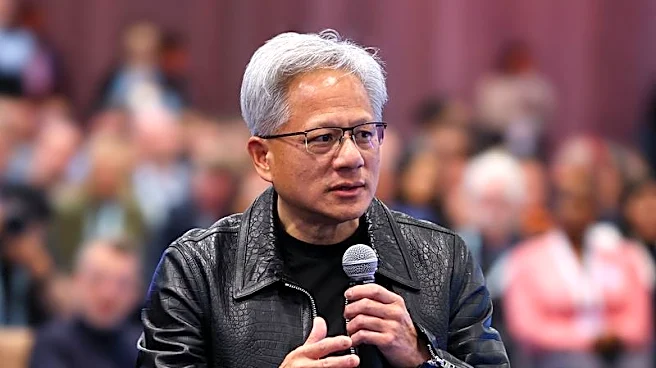
Jensen Huang, CEO of Nvidia, is a strong proponent of rapid AI development and deployment with minimal regulation, a stance that places him at odds with some industry leaders and experts who advocate for a pause or slowdown in foundational model development.
Huang emphasizes that AI is essentially software and math, not a new species, and that concerns about existential risks are often exaggerated. He believes that product safety and quality are paramount, stating that if an AI product is not safe, it should not be released. Huang's perspective focuses on engineering solutions for AI safety, such as containment systems, monitoring, and semantic detection, rather than broad legislative interventions. He views the current calls for a pause in AI development as potentially hindering the United States' opportunity to benefit from the technology. Huang also suggests that while AI may lead to a loss of some traditional skills, it will foster the development of new ones.
Why It's Important?
Huang's influential position as the head of Nvidia, a company central to AI hardware development, means his views significantly impact the direction of the AI industry. His advocacy for minimal regulation and rapid deployment could accelerate technological advancements but also raises concerns about unchecked development and potential societal impacts. If his perspective prevails, it could lead to a less regulated AI landscape in the U.S., potentially fostering innovation but also increasing the onus on developers for self-regulation and product safety. This approach contrasts with calls for more stringent oversight, creating a tension between rapid progress and cautious development. The debate over AI regulation has profound implications for job markets, education, and the ethical deployment of powerful technologies, affecting various sectors from technology to finance and beyond.
What's Next?
The ongoing debate between rapid AI development and regulatory caution is likely to intensify. Huang's continued advocacy for a pragmatic, engineering-focused approach to AI safety suggests that Nvidia will likely continue to push for technological solutions rather than legislative ones. This could influence policy discussions in the U.S., potentially leading to a focus on industry-led safety standards and best practices. However, the concerns raised by other leaders and experts about the potential risks of AI may still lead to some form of governmental oversight or international collaboration on AI governance. The industry will likely see continued investment in AI safety technologies, such as advanced monitoring and containment systems, as companies strive to balance innovation with responsible deployment. The long-term impact on education and workforce skills will also be a key area to watch as AI integration progresses.
Beyond the Headlines
Huang's comments reveal a deeper philosophical divide within the tech community regarding the nature and future of AI. His dismissal of 'doomerism' and 'alarmism' highlights a tension between those who view AI as a controllable tool and those who see it as a potentially autonomous entity with unforeseen consequences. This perspective also touches on the broader societal implications of technological advancement, particularly the question of whether humanity should prioritize innovation at all costs or proceed with extreme caution. The discussion around AI's impact on human skills, such as basic math, raises questions about the evolving definition of intelligence and competence in an AI-augmented world. Furthermore, Huang's views on energy consumption for AI and climate change suggest a complex interplay between technological progress, environmental responsibility, and economic growth, indicating that the AI revolution is not just a technological shift but a multifaceted societal transformation.