




What's Happening?
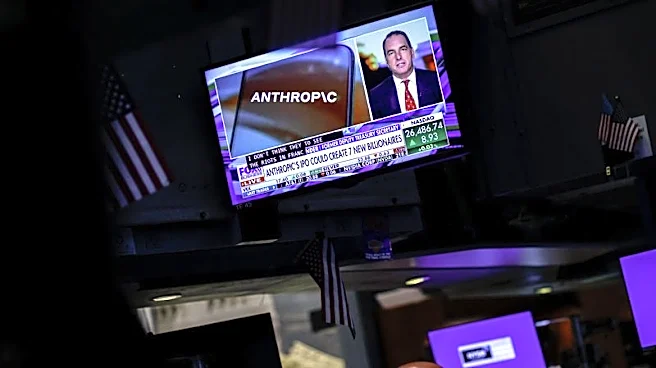
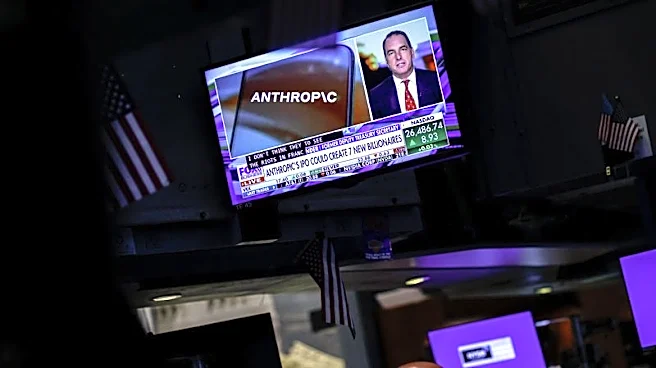
David Rosenthal of Acquired recently participated in a discussion regarding Anthropic's Initial Public Offering (IPO) and NVIDIA's stock performance. The conversation, recorded prior to Anthropic's pricing, delved into various market dynamics. Rosenthal and co-hosts
examined NVIDIA's stock, noting its 10% increase since June 2024 over 30 months, followed by a 3% decline at the time of the discussion. Anthropic's IPO was characterized as a 'fear buy' for retail investors, prompting a broader discussion on venture capital mathematics and the implications of a Series A to $1.5 trillion valuation run yielding a 322x return. The discussion also touched upon themes of modern governance versus 'feudalism 2.0' and the perceived value of techno-lus-divinum-regum.
Why It's Important?
This discussion is important for investors and market observers as it provides insights into the valuation and market sentiment surrounding significant technology companies like Anthropic and NVIDIA. The characterization of Anthropic's IPO as a 'fear buy' highlights potential speculative behavior among retail investors, which can lead to market volatility. The analysis of venture math, particularly the return multiples on large valuations, offers a critical perspective on the sustainability and profitability of high-growth tech investments. Furthermore, the debate on governance models, contrasting modern corporate structures with 'feudalism 2.0,' underscores evolving power dynamics within the tech industry and their potential impact on corporate control and shareholder value. These discussions can influence investment strategies and regulatory considerations in the rapidly changing tech landscape.
What's Next?
Following discussions like these, market participants will likely continue to closely monitor the performance of Anthropic post-IPO and NVIDIA's stock trajectory. The insights shared by experts like David Rosenthal can inform future investment decisions, particularly for those considering investments in AI and semiconductor sectors. The ongoing debate about venture capital returns and governance models may also prompt further scrutiny from financial analysts and regulatory bodies regarding market practices and investor protection. Companies in the tech sector might also re-evaluate their IPO strategies and corporate governance structures in light of these discussions, aiming to address investor concerns and maintain market confidence. The broader implications for the tech industry's valuation metrics and investment trends will continue to unfold.
Beyond the Headlines
The conversation extends beyond immediate market performance to touch upon deeper societal and economic implications. The concept of 'feudalism 2.0' in the context of tech governance suggests a potential concentration of power and wealth within a few dominant entities or individuals, raising questions about economic equity and market competition. The idea of a 'fear buy' in IPOs points to a broader psychological aspect of investing, where fear of missing out (FOMO) can drive irrational market behavior, potentially leading to bubbles or misallocations of capital. This highlights the ethical responsibility of financial commentators and the need for investor education to foster more informed decision-making. The discussion implicitly questions the long-term sustainability of current tech valuation models and the potential for systemic risks if these trends continue unchecked.