








What's Happening?
SES has announced it will lead the industrial activities for SELYCE, a new European initiative focused on developing technologies for future Direct-to-Device (D2D) satellite services. This project is conducted under a Partnership Project with the European Space
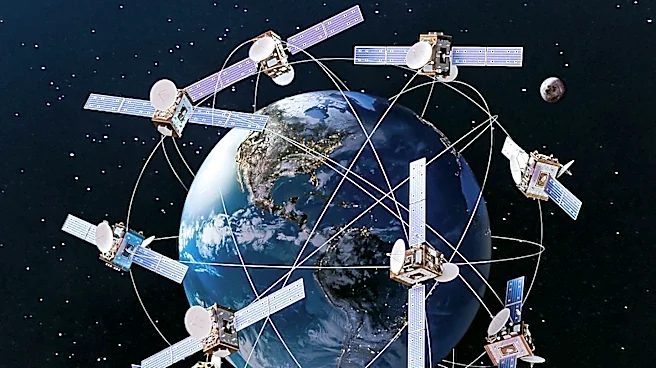
Agency (ESA) and supported by the Luxembourg Space Agency (LSA), Belgian Science Policy Office (BELSPO), and UK Space Agency (UKSA). SELYCE aims to advance standards-based 5G Non-Terrestrial Network (NTN) capabilities, enabling everyday smartphones and IoT devices to connect seamlessly via satellite beyond the reach of terrestrial networks. The initial focus will be on technologies supporting satellite connectivity for vehicles, messaging, and emergency communications services in areas without terrestrial coverage, as well as resilient communications during disasters. Dr. Xavier Bertran, Chief Product and Innovation Officer of SES, stated that D2D connectivity represents a significant evolution in how people and devices will remain connected.
Why It's Important?
The development of Direct-to-Device (D2D) satellite technologies is crucial for extending ubiquitous and resilient connectivity, particularly in remote areas or during critical situations where terrestrial networks may be unavailable or compromised. This initiative will enhance network resilience and enable new connectivity solutions for consumers, enterprises, and governments. For the U.S., while this is a European-led project, advancements in D2D technology have global implications, potentially influencing future standards and capabilities for satellite-based mobile connectivity worldwide. The ability to provide seamless connectivity to smartphones and IoT devices via satellite could significantly impact industries such as logistics, emergency services, and remote work, offering greater reliability and reach. Furthermore, the focus on standards-based 5G NTN capabilities suggests a move towards interoperable solutions, which could benefit global telecommunications ecosystems by fostering broader adoption and integration of satellite and terrestrial networks.
What's Next?
SES and its technology providers will follow a phased development approach, validating these D2D technologies in a high-fidelity end-to-end test environment. This validation process is intended to pave the way for future in-orbit demonstrations and commercial deployments. The SELYCE initiative also aims to foster collaboration across Europe's space and telecommunications sectors, supporting the development of an open, interoperable, and standards-based ecosystem for satellite-enabled mobile connectivity. This suggests that the project will continue to expand its network of participants and partners. The European Space Agency's 'Space for 5G/6G & Sustainable Connectivity' strategic program, under which SELYCE operates, is actively advancing 5G and 6G technologies to support Europe's digital transformation by integrating satellite and ground networks. This fusion is expected to revolutionize various applications, including smart mobility, global coverage, security, and network resilience, with ongoing efforts to promote standardization for seamless global connectivity.
Beyond the Headlines
The push for Direct-to-Device satellite connectivity, as exemplified by the SELYCE initiative, represents a significant step towards a truly global and resilient communication infrastructure. Beyond the immediate benefits of extended coverage and emergency communication, this technology could fundamentally alter the landscape of digital inclusion, bridging the connectivity gap for underserved populations and remote regions. Ethically, ensuring equitable access to these advanced services will be a key consideration. Legally, the standardization of 5G NTN capabilities will require international cooperation to navigate spectrum allocation and regulatory frameworks across different jurisdictions. Culturally, the ability for everyday devices to connect directly to satellites could lead to new forms of communication and data exchange, potentially impacting social interactions and economic models. Long-term, this development could accelerate the integration of space-based assets into daily life, making satellite connectivity as commonplace as terrestrial mobile networks and fostering innovation in areas like autonomous systems and global IoT deployments.