






What's Happening?
Hailey Bieber, founder of Rhode, has responded to public criticism regarding her use of the phrase 'optimistical delusion' during a recent interview. The controversy arose after Bieber stated that this mindset was crucial in her goal to sell her beauty
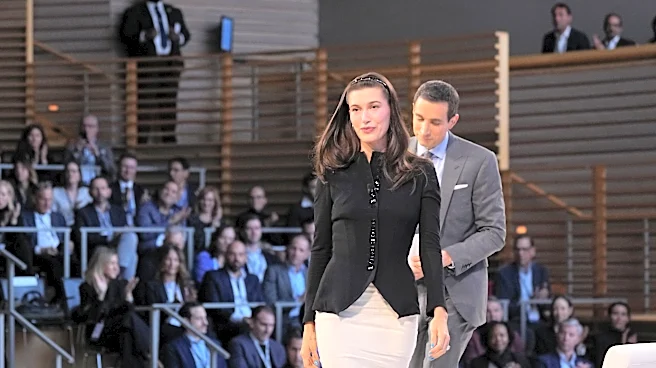
business for $1 billion to e.l.f. Beauty. Following online backlash and claims that 'optimistical' is not a real word, Bieber took to her Instagram Stories on November 20 to share a screenshot of a dictionary definition. The definition presented 'optimistical' as 'a version of optimistic,' effectively defending her word choice. Bieber made the original remark at the New York Times' DealBook Summit in New York City on November 18, where she discussed the May 2025 sale of her company and her ambitious financial target. She emphasized that setting a $1 billion valuation felt like 'shooting for the stars' and attributed the pursuit of such a goal to a 'certain sense of optimistical delusion.'
Why It's Important?
This incident highlights the intense scrutiny public figures, particularly those in the business and entertainment sectors, face regarding their language and public statements. For entrepreneurs like Hailey Bieber, who are building and selling brands, every public appearance and choice of words can be amplified and dissected by a broad audience. The swift online criticism and Bieber's subsequent defense underscore the immediate and pervasive nature of social media's impact on public perception. It also touches upon the broader cultural conversation around language evolution and usage, where informal or less common word forms can quickly become subjects of debate. For her brand, Rhode, and her personal image, effectively managing such public relations challenges is crucial for maintaining credibility and connection with consumers, especially in the competitive beauty industry where authenticity and relatability are highly valued.
What's Next?
In the immediate future, the public discussion around Hailey Bieber's word choice is likely to subside as the news cycle moves on. However, this event may contribute to a broader narrative about how public figures navigate online criticism and defend their intellectual or linguistic choices. For Bieber, continuing to focus on the success and growth of Rhode, particularly leading up to its sale to e.l.f. Beauty in May 2025, will be paramount. Her ability to maintain a strong public image and demonstrate business acumen will be key. This situation also serves as a reminder for other public figures and brands to be prepared for rapid online reactions to their statements, emphasizing the need for clear communication strategies and potentially proactive responses to anticipated scrutiny.
Beyond the Headlines
Beyond the immediate linguistic debate, this event subtly touches on the psychological aspects of entrepreneurship, particularly the role of 'delusion' or extreme optimism in achieving ambitious goals. Bieber's statement about 'optimistical delusion' suggests a mindset where belief in an improbable outcome can drive the actions necessary to achieve it. This concept is often discussed in business circles, where visionary thinking, even if initially perceived as unrealistic, can lead to groundbreaking success. The public's reaction, however, reveals a tension between admiring ambition and critiquing perceived linguistic or intellectual missteps. This dynamic reflects a broader societal tendency to scrutinize the perceived authenticity and intelligence of public figures, especially those who achieve significant financial success at a young age. It also highlights the ongoing evolution of language in the digital age, where informal usage can quickly become mainstream or, conversely, be met with immediate correction.