







What's Happening?
In the early 1980s, General Motors, under then-chairman and CEO Roger B. Smith, embarked on an aggressive automation strategy to revitalize the company amidst financial losses and competition from Japanese automakers. Inspired by a Toyota plant tour,
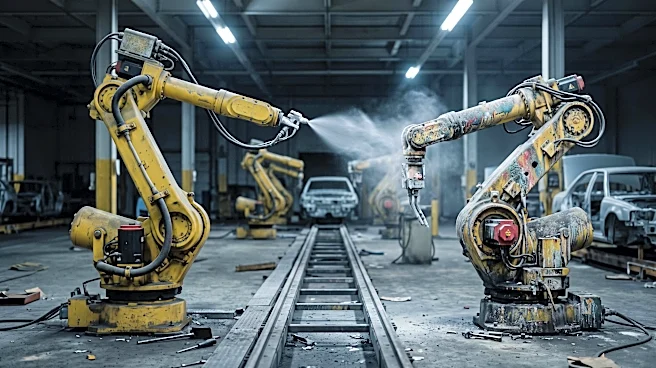
Smith envisioned a 'lights-out' factory, where robots would largely replace human labor. GM planned to increase its robot count from 302 in 1980 to 14,000 by the end of the decade, with a Saginaw, Michigan plant designed to boost productivity by 300%. However, this vision encountered significant practical challenges. The robots struggled to differentiate between car models, leading to incorrect part attachments and even painting each other instead of vehicles. These inefficiencies resulted in costs that surpassed those of traditional unionized plants, ultimately leading to the Saginaw factory's closure in 1992. The total cost of these automation efforts for General Motors was estimated at $40 billion, equivalent to approximately $95 billion in 2026.
Why It's Important?
This historical case from General Motors serves as a critical cautionary tale for U.S. industries considering large-scale automation, particularly with emerging technologies like AI. It highlights the significant financial risks and operational complexities involved when automation aspirations are misaligned with the practical realities of implementation. The failure of GM's 'lights-out' factory demonstrates that simply investing in advanced technology does not guarantee success; the technology must be capable of handling real-world complexities and integrated effectively. For businesses, this underscores the importance of thorough feasibility studies, realistic expectations, and a phased approach to automation rather than an all-encompassing, rapid deployment. The experience also suggests that human oversight and intervention remain crucial, especially in tasks requiring nuanced decision-making or adaptability, which robots of that era lacked. The substantial financial loss incurred by GM illustrates the potential for misjudged automation strategies to severely impact a company's bottom line and long-term viability.
What's Next?
The lessons from General Motors' early automation failures continue to resonate as U.S. industries increasingly explore advanced AI and robotics. Companies are likely to adopt more intentional and phased automation strategies, focusing on specific tasks where technology can genuinely add value rather than attempting to replace entire human workforces indiscriminately. There will be a continued emphasis on understanding the limitations of current AI and robotic capabilities, ensuring that systems are robust enough to handle the variability and complexity of real-world operations. Furthermore, the integration of AI will likely involve a 'human-in-the-loop' or 'human-on-the-loop' approach, where human workers collaborate with automated systems, providing oversight and intervening when necessary. This approach aims to mitigate the risks of complete automation failures and leverage the strengths of both human and machine intelligence. Future automation projects will likely prioritize effectiveness and strategic value over mere efficiency gains, learning from past mistakes where ambitious visions outpaced technological readiness.
Beyond the Headlines
The General Motors case highlights a deeper, recurring theme in technological adoption: the 'Automation Strategy Gap,' which is the misalignment between an organization's automation aspirations and the realities of successful implementation. This gap often arises from market pressures leading to reactive visions of full automation, resulting in disconnected execution and project failure. The ethical and societal implications of automation, such as job displacement and the changing nature of work, were foreshadowed by GM's attempt to create a 'lights-out' factory. While the word 'robot' itself originates from a play depicting synthetic beings created for forced labor, the GM experience demonstrated that replacing human labor is not always straightforward or cost-effective. This historical event also underscores the importance of considering the 'should you' alongside the 'could you' when it comes to automation, recognizing that not every task, even if technically automatable, should be fully automated due to factors like human preference, moral limits, or the need for human judgment in edge cases. The long-term shift triggered by such experiences is a more nuanced understanding of automation as a spectrum, where humans and machines often work in conjunction, rather than a binary choice between human or machine labor.