








What's Happening?
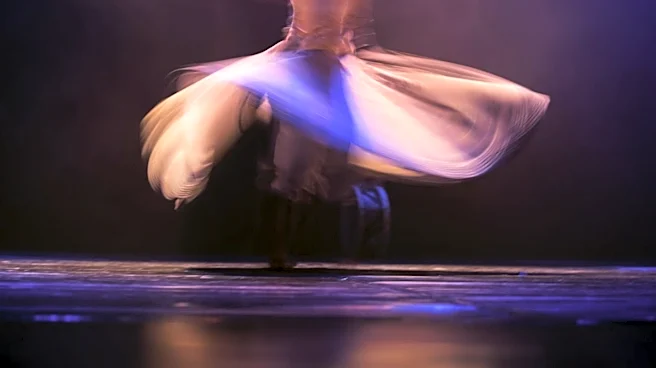
The San Francisco Ballet's production, 'Mere Mortals,' choreographed by Aszure Barton, offers a contemporary reinterpretation of the Pandora's Box myth, framing it as a cautionary tale about artificial intelligence. The ballet, which premiered in San Francisco in 2024
and is set for a European premiere at the Edinburgh International Festival, features a collaborative team including electronic musician Sam Shepherd (Floating Points) and digital art duo Hamill Industries, who designed visuals for giant LED screens. Barton emphasizes that while the subject matter is AI, the creative process was deeply human, focusing on collaboration with dancers like Jennifer Stahl, who performs the lead role of Pandora. The production explores the idea of Pandora as an agent of change, challenging traditional interpretations of the myth.
Why It's Important?
This ballet is significant as it reflects a growing cultural engagement with artificial intelligence, using a classical myth to explore modern anxieties and possibilities. For the U.S. arts scene, it showcases how traditional art forms like ballet are adapting to contemporary themes and integrating advanced technology, potentially attracting new audiences and pushing creative boundaries. The production's success could influence other artistic institutions to explore similar interdisciplinary approaches, blending dance, electronic music, and digital art. It also highlights San Francisco's role as a hub for both technological innovation and artistic expression, demonstrating how the city's identity as an AI center can inspire creative works that prompt reflection on technology's impact on humanity. The reinterpretation of Pandora's myth also encourages a deeper societal conversation about agency, responsibility, and the unforeseen consequences of technological advancement.
What's Next?
Following its European premiere, 'Mere Mortals' may embark on further international tours, expanding its reach and impact. The production's innovative blend of classical ballet with modern themes and technology could inspire other choreographers and artistic directors to explore similar contemporary narratives. We might see an increase in collaborations between performing arts companies and technology experts, leading to more tech-integrated performances. The discussions sparked by the ballet regarding AI's role in society and the re-evaluation of ancient myths are likely to continue, influencing critical discourse in both the arts and technology sectors. The success of 'Mere Mortals' could also solidify Aszure Barton's reputation as a leading contemporary choreographer capable of addressing complex modern issues through dance.
Beyond the Headlines
Beyond its artistic merit, 'Mere Mortals' delves into profound philosophical questions about humanity's relationship with technology and the nature of creation. By reimagining Pandora's box as unleashing AI, the ballet implicitly questions whether technological progress, much like the mythical release of evils, carries inherent risks that humanity must confront. It also challenges the traditional narrative of Pandora as a purely destructive figure, instead portraying her as an agent of change, which can be interpreted as a call to view AI not just as a threat but as a transformative force with potential for both good and ill. This nuanced perspective encourages a more complex understanding of AI's ethical implications, moving beyond simplistic dystopian or utopian views to consider the agency and responsibility involved in its development and deployment. The ballet serves as a cultural touchstone for examining how society grapples with powerful new technologies.