
What's Happening?
Ethereum, the second-largest cryptocurrency by market capitalization, has completed a significant upgrade known as 'The Merge.' This transformation, which occurred on September 15, 2022, combines Ethereum's
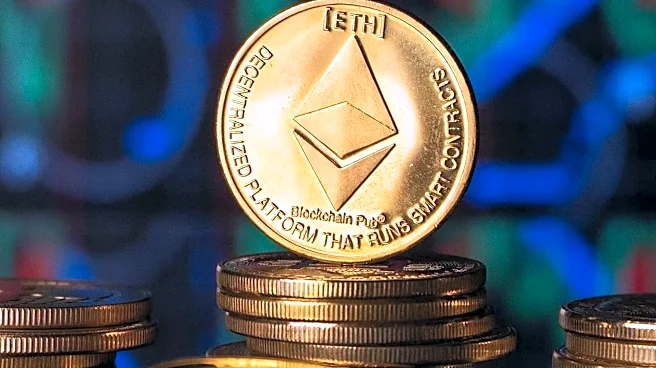
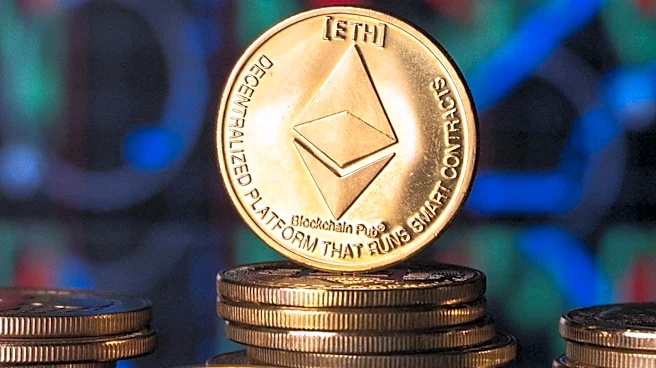
original blockchain with a new, separate proof-of-stake blockchain. According to its developers, this merger is designed to reduce the energy consumption of the Ethereum blockchain by 99.9%. The update also aims to make transactions cheaper and more environmentally friendly. Ether, the native currency of the Ethereum platform, is distinct from Ethereum itself, with Ether being the token used to pay for transactions on the Ethereum blockchain. The platform, created in 2015 by programmer Vitalik Buterin, is an open-source blockchain that facilitates decentralized and collaborative applications, including smart contracts that execute autonomously.
Why It's Important?
The 'Merge' update is a pivotal development for the cryptocurrency market, particularly for Ethereum's standing against its primary rival, Bitcoin. By drastically reducing its energy consumption, Ethereum addresses a major criticism leveled against blockchain technologies: their environmental impact. This move could enhance Ethereum's appeal to environmentally conscious investors and institutions, potentially increasing its adoption and usage. The shift to a proof-of-stake mechanism, where Ether owners lock up their cryptocurrency to verify new records and earn new coins, also changes the economic model of the network. Proponents believe this will make Ethereum more favorable and could lead to increased use of its platform for decentralized applications and smart contracts, impacting the broader digital economy.
What's Next?
Following 'The Merge,' Ethereum is expected to continue its evolution, with developers focusing on further scaling capacity and exploring a shift from a deflationary gas-burning narrative towards a store-of-value positioning. The reduced energy consumption and potentially cheaper transactions could attract more developers and users to the Ethereum ecosystem, fostering innovation in decentralized finance (DeFi), non-fungible tokens (NFTs), and other Web3 applications. The success of this transition could influence future developments in other blockchain networks, potentially encouraging similar energy-efficient upgrades across the industry. Market sentiment and the actual impact on transaction costs and network speed will be closely watched as the ecosystem adapts to these fundamental changes.
Beyond the Headlines
Beyond the immediate technical and economic implications, 'The Merge' represents a significant philosophical shift within the blockchain community. It underscores a growing emphasis on sustainability and efficiency, challenging the energy-intensive models that have characterized early cryptocurrency development. This move could set a precedent for how blockchain technology evolves, pushing for more responsible and scalable solutions. The transition also highlights the ongoing debate about centralization versus decentralization within blockchain networks, as the proof-of-stake model introduces new dynamics regarding validator participation and network governance. The long-term success of Ethereum's new model could influence regulatory approaches to cryptocurrencies, particularly concerning environmental impact and market stability.