







What's Happening?
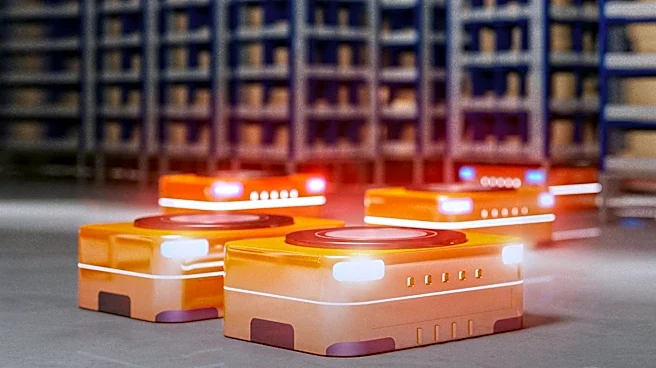
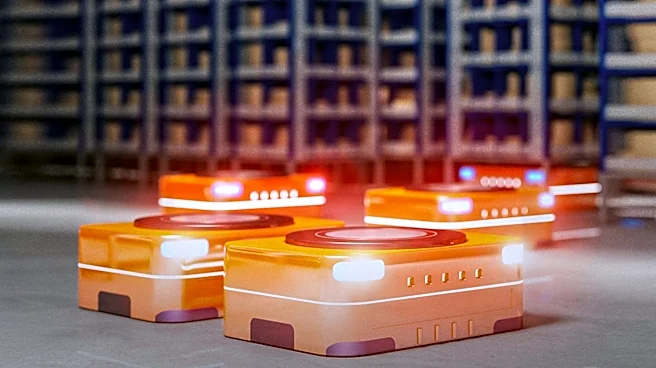
Walmart has announced a commitment of approximately $6 billion over several years to expand its automation deal with Symbotic. This expansion will integrate Symbotic's robotics technology into 25 additional U.S. regional distribution centers. The two
companies have been collaborating since 2017, with Symbotic already deploying its systems across all 42 of Walmart's regional distribution centers as of early 2025. The investment includes Symbotic’s BreakPack each-picking and SymMicro micro-fulfillment systems, along with $125 million for racking research. This move aims to enhance efficiency and reduce fulfillment costs, particularly as global e-commerce sales continue to grow, making up 24% of Walmart's net sales last quarter. More than 60% of Walmart stores currently receive shipments from automated distribution centers, and about half of e-commerce fulfillment center volume was automated in fiscal 2026.
Why It's Important?
This significant investment by Walmart underscores a broader trend in the retail industry towards automation to manage rising operational costs and meet increasing e-commerce demands. By automating its distribution centers, Walmart aims to achieve faster replenishment times and lower its cost to serve customers, which is crucial for maintaining competitiveness against rivals like Amazon. The focus on automation is particularly vital for online sales, where fulfillment costs are highest. This strategic shift could set a precedent for other large retailers, influencing how they invest in supply chain infrastructure and technology. For consumers, this could translate to faster delivery times and potentially more stable pricing due to reduced operational expenses. For the labor market, it signals a potential shift in job roles within the logistics sector, emphasizing technical skills over manual labor.
What's Next?
Walmart is expected to report its third-quarter results on November 19, where investors will closely monitor e-commerce profitability and any updates on capital expenditure plans related to this automation initiative. The company's near-term guidance is modest, with an expected 2% to 4% growth in third-quarter adjusted operating income. The success of this $6 billion investment will be crucial for Walmart to justify its current stock valuation, which trades at 40 times forward earnings. The expansion of robotics is anticipated to continue over several years, gradually transforming Walmart's logistics network. This ongoing automation push will likely influence future investment decisions and operational strategies across the retail sector, as companies seek to optimize their supply chains for efficiency and cost-effectiveness.
Beyond the Headlines
Walmart's substantial investment in robotics highlights the increasing reliance of major retailers on advanced technology to navigate complex market dynamics. This move reflects a strategic imperative to protect margins in a highly competitive retail landscape, where e-commerce growth is both an opportunity and a cost challenge. The integration of AI-powered robotics raises deeper questions about the future of work, the balance between human labor and automation, and the ethical implications of such widespread technological adoption. While automation promises efficiency and cost savings, it also necessitates a re-evaluation of workforce training and development to adapt to new roles. This trend could accelerate the digital transformation of the retail supply chain, potentially leading to a more resilient and responsive system capable of handling future disruptions and evolving consumer expectations.