






What's Happening?
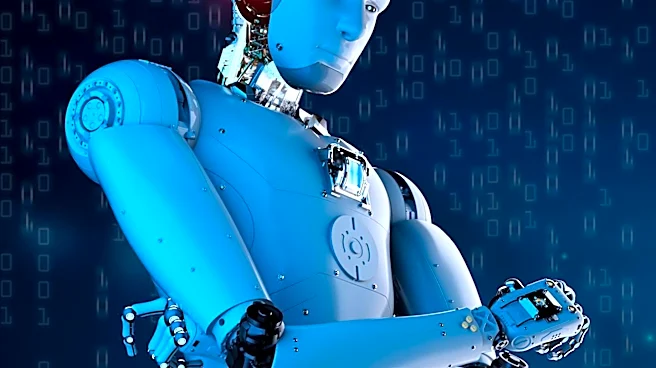
Wang Xingxing, founder and CEO of Chinese giant Unitree Robotics, stated that recent advancements in OpenAI's artificial intelligence, specifically the GPT-6 model, could trigger a significant breakthrough in the robotics industry as early as next year.
Speaking at an industry event in Shanghai, Wang suggested that a potential GPT-7 model, anticipated for release next year, might directly address and solve challenges related to 'embodied intelligence.' This projection marks an acceleration from his earlier estimate in August, prior to GPT-6's release, where he predicted that the industry would take two to three years, or even up to a decade, to achieve its 'ChatGPT moment'—a critical point of technological maturity. The rapid progress in AI models is now seen as a potential catalyst for a quicker evolution in robotics.
Why It's Important?
This development is significant for the U.S. technology sector, particularly in artificial intelligence and robotics. A breakthrough in embodied intelligence, driven by advanced AI models like GPT-6 or GPT-7, could revolutionize various industries, including manufacturing, logistics, healthcare, and defense. U.S. companies involved in AI research, robotics development, and automation stand to gain immensely from such advancements, potentially leading to new products, services, and increased efficiency. Conversely, industries reliant on manual labor might face significant disruption, necessitating workforce retraining and adaptation strategies. The accelerated timeline also intensifies the global race for AI dominance, with U.S. firms needing to maintain their competitive edge against international counterparts like Unitree Robotics. The implications extend to national security, as advanced robotics could enhance military capabilities and surveillance technologies.
What's Next?
The immediate focus will be on the continued development and release of subsequent OpenAI models, particularly GPT-7, and their capabilities in embodied intelligence. Robotics companies, both in the U.S. and globally, will likely intensify their research and development efforts to integrate these advanced AI models into their robotic systems. We can anticipate increased collaboration between AI developers and robotics manufacturers, as well as a surge in investment in this sector. Regulatory bodies may also begin to consider the ethical and societal implications of more sophisticated autonomous robots, potentially leading to new policy discussions. The performance of these AI-powered robots in real-world applications will be closely monitored, with early successes likely to drive further adoption and innovation.
Beyond the Headlines
The potential for a 'ChatGPT moment' in embodied intelligence raises profound questions about the future of human-robot interaction and the nature of work. If robots can achieve a high level of intelligence and autonomy, it could fundamentally alter economic structures and societal norms. Ethical considerations regarding robot rights, accountability for autonomous actions, and the potential for job displacement will become increasingly pressing. The long-term shift could see a redefinition of human roles in the economy, moving towards tasks that require creativity, critical thinking, and interpersonal skills, while repetitive or dangerous tasks are increasingly handled by intelligent machines. This technological leap could also exacerbate existing inequalities if access to and benefits from these advancements are not equitably distributed.