



What's Happening?
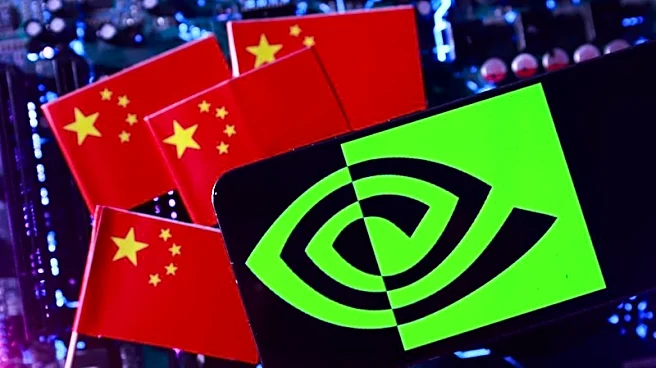
The Chinese AI stock market has experienced a significant downturn, with tech-focused indexes losing a combined $1.7 trillion in market value since June. This decline is attributed to frothy valuations, reliance on policy support, and increased U.S. restrictions
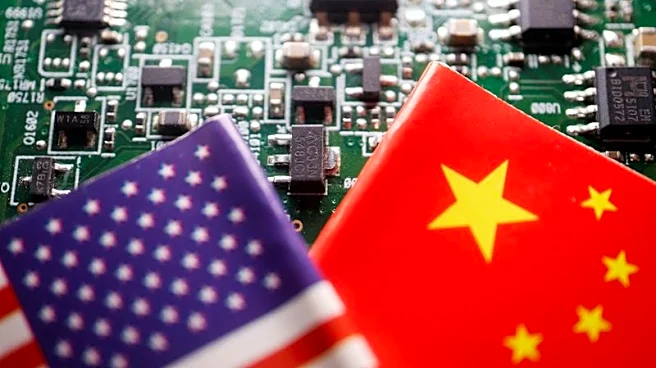
on technology exports. Specifically, new draft rules from the U.S. aim to prevent Chinese firms from accessing cutting-edge processors from companies like Nvidia Corp. via overseas data centers, a crucial avenue for training advanced AI models. This has led to concerns about the sustainability of the US-China supply chain business. While Chinese tech firms like Huawei and Cambricon Technologies Corp. have a notable share in the chips used by China's tech sector, with Cambricon holding about 22% in the first half of 2026 according to Nomura Holdings Inc., the tightening U.S. regulations are expected to impede their progress. The market's anxiety over the viability of the AI trade has resulted in a rout, with Chinese tech indexes now showing losses for the year, contrasting with positive territories in the U.S., Taiwan, and South Korea.
Why It's Important?
The escalating U.S. tech and compute curbs have significant implications for the global technology landscape and U.S. economic interests. By restricting access to advanced AI processors, the U.S. aims to slow China's technological advancement, particularly in artificial intelligence, which is seen as a critical area for national security and economic competitiveness. This move could bolster the competitive advantage of U.S. AI companies by limiting the resources available to their Chinese counterparts. However, it also creates uncertainty for U.S. chip manufacturers like Nvidia, who rely on the Chinese market for a portion of their revenue. The restrictions could also accelerate China's drive for technological self-sufficiency, potentially leading to increased investment in domestic semiconductor industries. For U.S. investors, the volatility in the Chinese AI market, partly driven by these restrictions, highlights the risks associated with international tech investments and the impact of geopolitical tensions on market performance.
What's Next?
The immediate future will likely see Chinese tech firms grappling with the implications of the tightened U.S. export restrictions. Companies like Tencent have already warned of potential delays in their AI model development due to chip shortages, although they anticipate domestic supply chains may eventually fill the gap. Alibaba also projects a slowdown in cloud sales growth before a potential rebound. The restrictions are expected to intensify China's efforts to develop its own advanced chip technology, potentially benefiting local foundries like Semiconductor Manufacturing International Corp. as overseas manufacturers might reject orders. Investors will continue to monitor the effectiveness of these U.S. curbs and China's response, which could include increased government support for domestic chip production and AI research. The market will also be watching for any further escalations or de-escalations in U.S.-China tech relations, which will undoubtedly influence investment strategies and the global AI development trajectory.
Beyond the Headlines
The U.S. strategy of restricting technology exports to China extends beyond immediate economic competition, touching upon deeper geopolitical and ethical considerations. This approach reflects a broader U.S. policy to maintain technological leadership and address national security concerns related to China's AI capabilities. The long-term implications could include a more fragmented global technology ecosystem, with distinct supply chains and technological standards emerging in the U.S. and China. This could lead to a 'decoupling' of technological development, potentially slowing global innovation in some areas while accelerating it in others due to increased domestic competition. Ethically, the restrictions raise questions about the free flow of scientific knowledge and technology, and whether such measures ultimately foster or hinder global progress. The push for technological self-sufficiency in China, driven by these restrictions, could also lead to significant shifts in global power dynamics and influence, as nations increasingly prioritize domestic technological independence.