

What's Happening?
Uber Eats has officially launched its drone delivery service in Spring, Texas, a suburb of Houston, in partnership with drone delivery company Zipline. This initiative, announced on ABC’s “Good Morning America,” marks the first deployment of a program
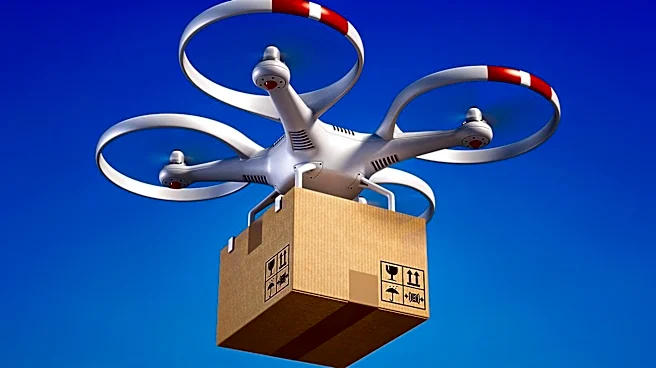
aimed at integrating drones into Uber Eats' delivery network. The service allows customers in the Spring area to specifically request drone delivery for their orders. Zipline’s drones are capable of traveling up to 70 mph, carrying up to eight pounds, and operating in various weather conditions. After a restaurant prepares an order, a Zipline drone flies to the customer's location and lowers the food onto the front lawn using a tethered delivery pod, maintaining an altitude of over 300 feet. Uber Eats plans to expand this drone program to Dallas, Texas, and other U.S. cities, with a long-term goal of achieving one million drone deliveries per day by the end of 2029.
Why It's Important?
The launch of Uber Eats' drone delivery service signifies a significant step forward in the evolution of last-mile logistics and the broader gig economy. This move could revolutionize food delivery by drastically reducing delivery times, with Zipline CEO Keller Cliffton stating the goal is to achieve delivery within 10 minutes. Faster delivery times could enhance customer satisfaction and increase order frequency, benefiting both Uber Eats and its partner restaurants. For the U.S. economy, this expansion represents a growing investment in autonomous delivery technologies, potentially creating new jobs in drone operations, maintenance, and software development. It also intensifies competition within the delivery sector, pushing other companies to innovate and adopt similar technologies. The integration of drones into the delivery network could also alleviate some of the pressures on traditional courier services, especially in areas with traffic congestion or limited access, while also raising questions about the future of human delivery drivers.
What's Next?
Following the initial launch in Spring, Texas, Uber Eats and Zipline plan to expand their drone delivery program to Dallas, Texas, and subsequently to other major U.S. cities. This phased expansion will likely involve further regulatory approvals and infrastructure development to support widespread drone operations. The companies aim to scale up their operations significantly, targeting one million drone deliveries per day by the end of 2029. This ambitious goal suggests a future where drone delivery becomes a common option for consumers. As the service expands, Uber Eats will likely gather data on efficiency, customer satisfaction, and operational challenges to refine its model. The success and expansion of this program could also influence other delivery platforms and logistics companies to accelerate their own drone integration plans, potentially leading to a more widespread adoption of drone delivery across various industries in the U.S.
Beyond the Headlines
The introduction of widespread drone delivery services by major players like Uber Eats carries profound implications beyond mere convenience. Ethically, it raises questions about noise pollution in residential areas, potential privacy concerns related to drones flying over private property, and the environmental impact of increased drone manufacturing and operation. Legally, the expansion will necessitate ongoing collaboration with aviation authorities to establish clear regulations for drone flight paths, airspace management, and safety protocols, especially as drone traffic increases. Socially, the shift towards autonomous delivery could alter urban landscapes, potentially reducing street traffic from delivery vehicles but introducing new elements into the sky. It also prompts a re-evaluation of labor markets, as the demand for human delivery drivers might decrease in favor of drone operators and maintenance technicians. This technological leap could fundamentally reshape consumer expectations for speed and efficiency in delivery services, setting new standards for instant gratification in the retail and food sectors.