






What's Happening?
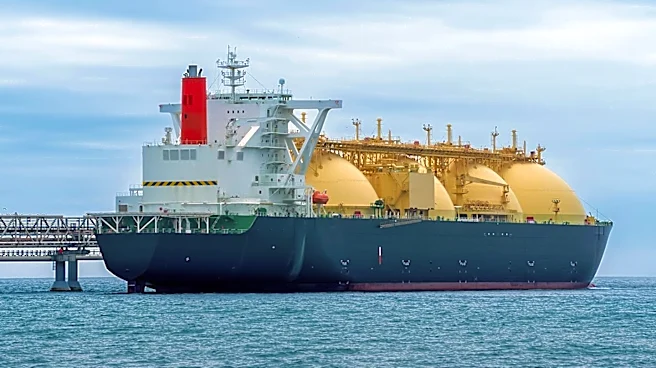
Dynagas LNG Partners, an Athens-based shipping company, reported a 29.3% increase in adjusted net income for the third quarter of 2026, reaching $18.4 million compared to $14.2 million a year prior. This growth was driven by higher LNG carrier charter
revenues, full fleet utilization, and reduced financing costs. Voyage revenues rose by 13.1% to $44 million, reflecting improved charter rates and stronger vessel employment. The company's six LNG carriers achieved 100% utilization during the quarter, up from 99.1% in the corresponding period of 2025. Average time charter equivalent rates increased by 11.8% year-over-year to $75,027 per vessel per day, significantly exceeding the company's quarterly cash breakeven rate of approximately $47,100. The company's balance sheet also improved, with cash holdings reaching $79.9 million at the end of September, up from $41 million at the end of 2025. Dynagas repaid $33.1 million in debt during the first nine months of 2026, reducing outstanding financial liabilities to approximately $245.6 million.
Why It's Important?
The improved financial performance of Dynagas LNG Partners highlights the current strength in the LNG shipping market, partly fueled by increasing U.S. LNG export activity. The company's new charters with Rio Grande LNG for its 'Clean Energy' and 'Arctic Aurora' vessels demonstrate a strategic shift towards strengthening its exposure to the U.S. market, providing greater visibility into future shipping revenues. This is crucial for the U.S. energy sector as it indicates robust demand for LNG transportation, supporting the expansion of U.S. export capacity. However, the significant risk posed by tightening Western sanctions on Russian LNG shipments, particularly the UK's new restrictions on services supporting Russian-origin LNG, could severely impact Dynagas. Two of its vessels, 'Yenisei River' and 'Lena River,' operate under long-term agreements with Yamal Trade, accounting for approximately 56% of the company's estimated revenue backlog. The potential disruption to insurance coverage for these vessels starting January 1, 2027, could lead to charter disputes, lost revenue, or early termination of contracts, underscoring the geopolitical risks inherent in global energy trade and its direct impact on shipping companies.
What's Next?
Dynagas LNG Partners faces an immediate challenge in securing replacement protection and indemnity, as well as hull and machinery insurance, for its two vessels operating under long-term agreements with Yamal Trade. The new UK restrictions on services supporting Russian-origin LNG shipments could disrupt existing insurance coverage starting January 1, 2027. Despite ongoing discussions with alternative providers, the company has not yet secured suitable coverage. Failure to obtain this insurance could lead to significant financial repercussions, including charter disputes, lost revenue, or the early termination of these lucrative contracts, which represent a substantial portion of its revenue backlog. The evolving restrictions from the European Union on Russian LNG imports and transfers also add to the uncertainty, although Dynagas believes its current Yamal shipping arrangements may qualify for an exemption for legacy contracts and shipments outside the EU. The company's ability to navigate these geopolitical complexities and secure its Russian LNG contracts will be a critical factor for its future cash flow and investor returns.
Beyond the Headlines
The situation with Dynagas LNG Partners exemplifies the broader implications of geopolitical tensions on global supply chains and the energy sector. The increasing divide in global LNG shipping, where expanding U.S. export capacity creates new commercial opportunities while sanctions on Russian energy trade threaten established arrangements, highlights a fundamental reshaping of energy logistics. For companies like Dynagas, balancing growth in new markets, such as U.S. LNG exports, with the risks associated with existing contracts in sanctioned regions becomes a complex strategic imperative. This scenario also underscores the critical role of insurance and financial services in international trade, as their withdrawal due to sanctions can effectively halt operations, even for contracts that are otherwise commercially viable. The long-term shift could see a more fragmented global energy market, with distinct supply chains emerging based on geopolitical alignments, potentially leading to increased costs and reduced efficiency in the global movement of energy resources.