







What's Happening?
The mobile application development landscape is undergoing rapid transformation, driven by the integration of Artificial Intelligence (AI), Machine Learning (ML), 5G connectivity, and spatial computing technologies like Augmented Reality (AR) and Virtual
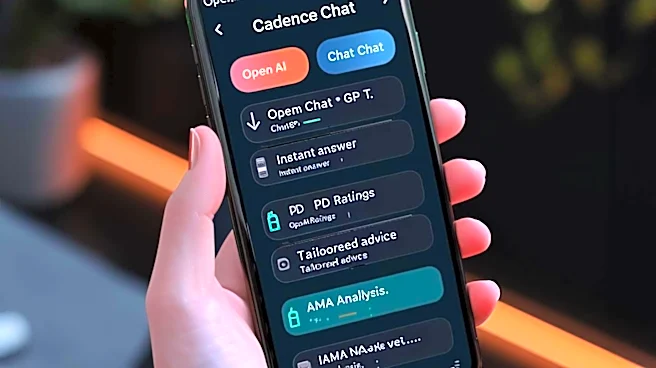
Reality (VR). Developers are moving towards creating proactive, intelligent applications that offer hyper-personalized content and adaptive user interfaces. Generative AI is enabling conversational agents and dynamic content creation, while 'Edge AI' processes algorithms locally on devices, improving performance and data privacy. The widespread rollout of 5G is providing ultra-low latency and high bandwidth, enabling seamless streaming, real-time gaming, and instantaneous data transfer, which in turn supports complex AR systems and extensive Internet of Things (IoT) ecosystems. Spatial computing is maturing beyond entertainment, with AR and VR becoming essential tools in retail for 'try-before-you-buy' features and in healthcare for training and diagnostics.
Why It's Important?
These advancements are profoundly impacting U.S. industries by setting new standards for user expectations and operational efficiency. Businesses that fail to adopt these technologies risk falling behind competitors who are leveraging AI for personalization, 5G for enhanced connectivity, and AR/VR for immersive experiences. The rise of 'Super Apps,' originating in Eastern markets and gaining global traction, signifies a consumer demand for consolidated, all-in-one platforms, presenting both challenges and opportunities for developers and businesses to integrate diverse services. Furthermore, the emphasis on security and privacy, with the adoption of biometric authentication and 'privacy by design' principles, is critical for maintaining user trust and complying with increasingly stringent regulatory frameworks like GDPR and state-level privacy laws. This technological convergence is reshaping how businesses interact with customers, manage data, and deliver services, making mobile apps central to competitive strategy.
What's Next?
The trajectory of mobile app development points towards continued integration and amplification of these advanced technologies. We can expect further innovation in AI and ML to create even more intuitive and predictive user experiences. The full potential of 5G will be realized as infrastructure matures, enabling more sophisticated cloud-based processing and real-time interactions. Spatial computing will likely expand into more industries, offering new ways for users to interact with digital content in physical spaces. The 'Super App' model is anticipated to gain further traction, prompting businesses to consider how their services can be integrated into broader ecosystems. Developers will continue to prioritize cross-platform solutions like Kotlin Multiplatform (KMP) to optimize development efficiency while maintaining native performance. A non-negotiable focus on robust security measures and transparent privacy practices will remain paramount, driven by both consumer demand and regulatory pressures.
Beyond the Headlines
The convergence of AI, 5G, and spatial computing in mobile app development signifies a fundamental shift in human-technology interaction. This evolution moves beyond simple utility to create deeply integrated, intelligent, and immersive digital experiences that blur the lines between the physical and virtual worlds. Ethically, the increased personalization and data collection raise concerns about privacy and algorithmic bias, necessitating careful consideration of 'privacy by design' and transparent data handling. Legally, evolving regulatory frameworks will continue to shape how data is collected, processed, and secured, impacting app design and business models. Culturally, these technologies are changing how individuals connect, consume information, and conduct daily tasks, potentially leading to new forms of social interaction and digital dependency. The long-term implications include a more interconnected society, where mobile devices serve as central hubs for managing an increasingly complex digital and physical existence, demanding a continuous re-evaluation of digital ethics and user autonomy.