


What's Happening?
Actress Sarah Paulson, a prominent figure in the 'American Horror Story' (AHS) series, has once again publicly stated her strong dislike for the 'Roanoke' season. During a red carpet event for the launch of AHS Season 13, Paulson was asked by Entertainment
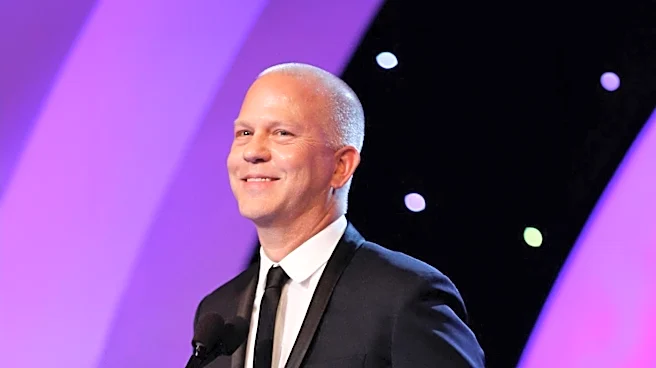
Tonight to rank the characters she has played throughout the series. She used this opportunity to reiterate her disdain for 'Roanoke,' placing it at the very bottom of her list. Paulson explicitly stated, 'Roanoke is at the end. People are mad at me. I don't care. Go f*** yourselves! I don't give a s***. Sorry! I don't like it! It's not for me!' She acknowledged that while there were aspects of the season she liked, the overall experience was not to her taste. This sentiment was met with a playful response from AHS co-creator Ryan Murphy, who commented on a video of her remarks, defending 'Roanoke' as his favorite season and noting their past disagreements on the matter. The 'Roanoke' season, which aired as the sixth installment of the anthology series, featured a multi-layered narrative structure, beginning with a mockumentary and transitioning into a found-footage style, which Paulson implied was a less straightforward formula.
Why It's Important?
Sarah Paulson's candid remarks about her least favorite 'American Horror Story' season are significant for several reasons within the entertainment industry. As one of the most recognizable and critically acclaimed actors in the franchise, her public opinion can influence fan perception and discussions around the show's legacy. For fans, her comments provide an insider's perspective on the creative process and personal experiences of the cast, potentially validating or challenging their own views on 'Roanoke.' For the show's creators and network, such statements, while potentially controversial, can also generate buzz and renewed interest in past seasons, prompting viewers to revisit 'Roanoke' to form their own conclusions. This kind of open dialogue from a lead actor can also highlight the subjective nature of artistic appreciation, even among those directly involved in a production. Furthermore, it underscores the unique dynamic between actors and the roles they inhabit, demonstrating that even beloved performers may have personal preferences that diverge from critical or popular consensus.
What's Next?
Following Sarah Paulson's renewed public declaration regarding 'American Horror Story: Roanoke,' it is likely that discussions among fans and critics will intensify, particularly as the 13th season of AHS is currently airing. Social media platforms and fan forums are expected to see increased debate about the merits and flaws of 'Roanoke,' potentially leading to a re-evaluation of the season by some viewers. Ryan Murphy's playful defense of 'Roanoke' suggests that this is a known, lighthearted disagreement within the AHS family, and it is unlikely to cause any significant professional repercussions for Paulson. Instead, it may serve as a talking point in future interviews for both Paulson and other cast members, further fueling interest in the show's extensive catalog. The ongoing nature of the AHS anthology, which frequently brings back familiar faces and references past seasons, means that Paulson's comments could even inspire future narrative choices or fan engagement strategies, perhaps even a meta-commentary within the show itself.
Beyond the Headlines
Sarah Paulson's frankness about her disliking 'American Horror Story: Roanoke' delves into deeper implications regarding creative ownership and the actor's relationship with their work. In an industry often characterized by carefully curated public images, Paulson's willingness to express a strong, negative opinion about a project she was a part of highlights a growing trend of performers asserting their authentic voices. This can challenge the traditional expectation for actors to universally praise all their past projects. It also opens a conversation about the subjective experience of creating art versus consuming it; what might be a challenging or unfulfilling experience for an actor during production could still be appreciated by an audience. Furthermore, her comments, and Ryan Murphy's response, underscore the collaborative yet sometimes conflicting nature of creative partnerships in television production, where different individuals can have vastly different perspectives on the same artistic endeavor. This transparency can foster a more nuanced understanding of the complexities behind popular television series.