



What's Happening?
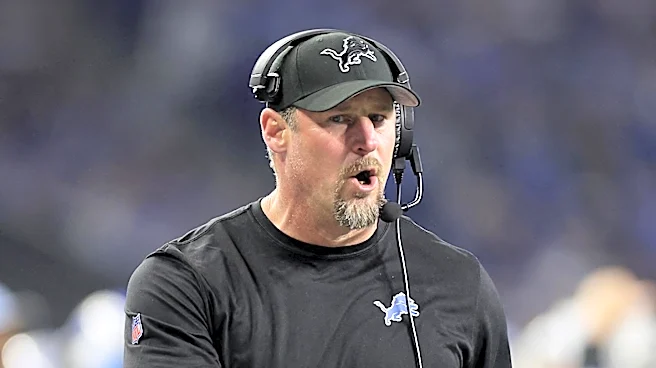
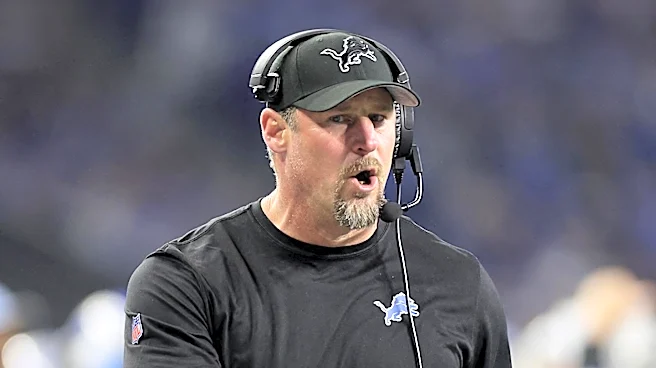
Detroit Lions Head Coach Dan Campbell has firmly stated that he will not delegate the responsibility of throwing the challenge flag to any member of his coaching staff. This declaration comes in response to a new NFL rule allowing head coaches to designate
another staff member to initiate the challenge process. Campbell emphasized that the ultimate accountability for such decisions rests with him, and therefore, he prefers to maintain direct control over when to challenge a call. His stance aligns with that of other head coaches, such as Patriots head coach Mike Vrabel, who also expressed a similar sentiment, indicating a common preference among many NFL head coaches to personally manage critical in-game decisions.
Why It's Important?
Dan Campbell's decision to retain sole control over the challenge flag is significant for several reasons. Firstly, it underscores the high-stakes nature of challenge decisions in the NFL, where a successful challenge can dramatically alter the momentum of a game, while an unsuccessful one can result in a costly timeout and loss of down. By keeping this responsibility, Campbell ensures that the decision-making process is centralized and directly reflects his strategic vision and understanding of the game situation. Secondly, it highlights the trust and accountability dynamics within an NFL coaching staff. Campbell's statement, 'The buck stops with me anyway. I’m answering the questions, so why would I give it to somebody else, for me to answer for somebody else?', clearly articulates his belief that ultimate responsibility should be accompanied by direct control. This approach can foster a clear chain of command during critical moments.
What's Next?
This decision by Coach Campbell will mean that during Detroit Lions games, all challenge flag decisions will continue to originate directly from him. This approach will be observed throughout the upcoming NFL season, and its effectiveness will be judged by the success rate of his challenges and the overall game management. Other NFL teams will likely continue to evaluate their own strategies regarding the new rule, with many head coaches expected to follow Campbell's lead in retaining personal control. The impact of this rule, and how various coaches choose to implement or disregard the delegation option, will be a point of discussion and analysis as the season progresses, potentially influencing future rule adjustments or coaching trends.
Beyond the Headlines
The NFL's new rule regarding challenge flag delegation touches upon broader themes of leadership, trust, and decision-making under pressure in high-performance environments. While the rule aims to potentially streamline the challenge process or allow coaches to focus on other aspects of the game, Campbell's rejection of it speaks to a leadership philosophy that values direct accountability and personal oversight in critical moments. It suggests that for some leaders, the perceived benefits of delegation do not outweigh the importance of personal control over outcomes for which they are ultimately responsible. This dynamic is not unique to sports but resonates across various leadership contexts, where the balance between empowering subordinates and maintaining ultimate authority is a constant challenge. It also highlights the psychological aspect of coaching, where confidence in one's own judgment can be a significant factor.