







What's Happening?
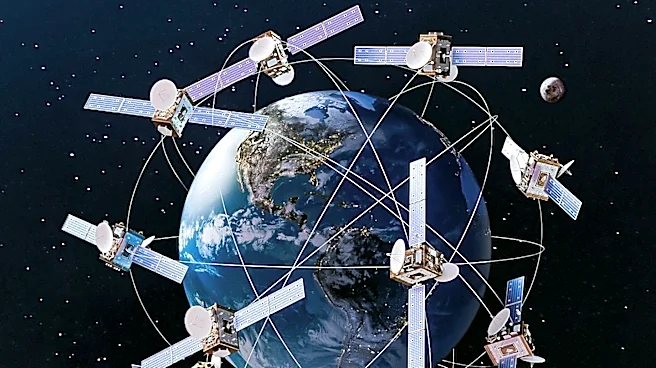
Qualcomm has entered into a multiyear agreement with SpaceX's Starlink to provide equipment for Starlink's terrestrial 5G network in the United States. This collaboration involves Qualcomm supplying custom silicon and software, including advanced massive
MIMO technology and purpose-built RAN processing, for Starlink's ambitious nationwide cellular network buildout. Qualcomm CEO Cristiano Amon confirmed that the company is designing custom silicon specifically for the 'Layer 1' category of network functions required for this project. This move positions Qualcomm, a 40-year-old American company known for its 5G patents, as a key player in Starlink's effort to establish a fully integrated satellite and terrestrial network, aiming to provide widespread mobile connectivity across the country. The partnership signifies a departure from traditional network vendors like Ericsson, Nokia, and Samsung, as Starlink opts for Qualcomm's specialized solutions.
Why It's Important?
This partnership is poised to significantly disrupt the U.S. 5G market, challenging the established order dominated by traditional vendors. By leveraging Qualcomm's custom silicon and software, Starlink aims to accelerate its deployment of a nationwide 5G network, potentially increasing competition and driving down customer prices. The incumbents, including AT&T, T-Mobile, and Verizon, face the prospect of a new, well-resourced entrant that could poach smartphone customers. This increased competition could force existing operators to invest more in upgrading their own mobile networks, potentially benefiting equipment suppliers like Ericsson, Nokia, and Samsung, but also risking a reduction in average revenue per user (ARPU) if prices fall to more European levels. Such a shift could impact the profitability of U.S. mobile operators and have global repercussions for the telecommunications industry, particularly for companies like Ericsson, which derive a significant portion of their revenue from the high-margin U.S. market.
What's Next?
The Starlink 5G network, powered by Qualcomm's technology, is expected to begin deployment in 2027. While Qualcomm will supply the core Layer 1 technology, Starlink will need to source other components, such as radio units (RUs) and software for Layers 2 and 3 of the network. SpaceX might choose to manufacture its own RUs based on Qualcomm's expertise or partner with contract manufacturers. The development of Layer 2 and Layer 3 software is likely to occur in-house at SpaceX, potentially running on third-party CPUs from Intel, AMD, or Qualcomm's own Arm-based CPUs. This ambitious undertaking could establish SpaceX not only as a network operator but also as a developer of network products, potentially expanding its reach to serve telcos in other parts of the world. The success of this venture will be closely watched, as it represents a significant investment and a potential paradigm shift in how cellular networks are built and operated.
Beyond the Headlines
The collaboration between Qualcomm and Starlink highlights a growing trend towards specialized, custom-built solutions in the telecommunications industry, moving away from general-purpose processors that have gained traction with some operators. While custom silicon offers superior efficiency and performance for specific tasks, it also presents challenges related to shorter lifespans and less adaptability to emerging features compared to general-purpose alternatives. This strategic choice by Starlink, backed by Qualcomm's expertise, suggests a prioritization of network quality and performance, even if it means greater dependence on a single technology provider. The long-term implications could include a re-evaluation of network architecture strategies across the industry, with a potential resurgence of custom silicon in areas where performance and efficiency are paramount. This could also lead to new business models where network operators become more involved in the development of their own network infrastructure, blurring the lines between service providers and equipment manufacturers.