



What's Happening?
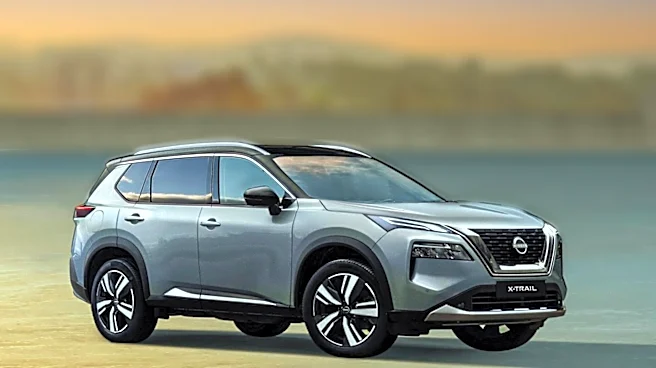
Nissan Motor is exploring the addition of a third production shift at its assembly plant in Smyrna, Tennessee. This consideration comes as the company prepares to launch the 2027 Rogue, which will include a new hybrid model. The Smyrna plant currently
operates on two production shifts, manufacturing the Rogue along with other Nissan and Infiniti crossovers. The decision to potentially add a third shift is driven by Nissan's goal to increase its U.S. production capacity, especially with the introduction of the hybrid Rogue, which is seen as a crucial offering for American consumers. U.S. manufacturing of the hybrid version is anticipated to commence next year, following the spring launch of the traditional gas-engine 2027 Rogue at the Tennessee facility. In the interim, Nissan plans to import hybrid vehicles from Japan to expedite their market entry and support the company's global turnaround strategy.
Why It's Important?
The potential addition of a third production shift at Nissan's Smyrna plant signifies a significant boost for U.S. manufacturing and the local economy in Tennessee. Such an expansion typically leads to the creation of hundreds, if not thousands, of new jobs, directly impacting employment rates and economic stability in the region. This move aligns with broader national efforts to increase domestic production in the U.S. auto industry. For Nissan, increasing U.S. production is a strategic step towards its target of manufacturing 80% of the vehicles it sells in the U.S. domestically by 2030. The introduction of the 2027 Rogue hybrid, particularly with its 'e-Power' technology, is critical for Nissan's competitiveness in the highly contested small crossover segment, where rivals like Toyota and Honda currently dominate hybrid sales. This focus on hybrids also reflects a shift in consumer demand and a response to the financial challenges faced by automakers with all-electric vehicles.
What's Next?
Nissan plans to begin U.S. manufacturing of the 2027 Rogue hybrid next year, after the spring launch of the gasoline-powered version at its Smyrna, Tennessee plant. Before U.S. production of the hybrid begins, Nissan will import these models from Japan to accelerate their market availability. The company aims to position the Rogue e-Power directly against the Toyota RAV4, even considering unconventional sales strategies such as allowing customers to test drive both vehicles at Nissan dealerships. While Nissan is optimistic about adding a third shift, which could nearly double its U.S. annual output to approximately 1 million units, the company currently has no plans for constructing new manufacturing plants. The success of the 2027 Rogue hybrid and the potential production expansion will be closely watched as indicators of Nissan's ongoing global turnaround efforts and its strategy for the U.S. market.
Beyond the Headlines
Nissan's strategic emphasis on hybrid technology, particularly the 'e-Power' system, highlights a broader industry trend of diversifying powertrain options beyond purely electric vehicles. This approach suggests a recognition that while electric vehicles are a long-term goal, hybrids offer a more immediate and practical solution for consumers facing fluctuating fuel prices and concerns about EV infrastructure. The decision to prioritize U.S. production and potentially add shifts in Smyrna also underscores the increasing importance of localized supply chains and manufacturing resilience. This could lead to a re-evaluation of global production strategies across the automotive sector, favoring regional hubs to mitigate risks and respond more effectively to local market demands. Furthermore, the competitive positioning against established hybrid leaders like Toyota could foster innovation and more consumer-centric offerings in the hybrid vehicle market.